Five KCOS faculty named Senior Members of National Academy of Inventors
The National Academy of Inventors (NAI) has announced the 2025 class of Senior Members, with seven of the newly named members from UNC Charlotte. Senior Members were selected from NAI’s member institutions for exemplifying the spirit of creativity and discovery that drives the global inventor community.
Five faculty from the Klein College of Science were named as Senior Members:
- Kirill Afonin, Ph.D., professor of chemistry
- Glenn Boreman, Ph.D., professor and department chair of physics and optical science
- Jordan C. Poler, Ph.D., professor of chemistry
- Susan R. Trammell, Ph.D., professor of physics and optical science
- Michael G. Walter, Ph.D., professor of chemistry and director of nanoscale science Ph.D. program
“This year’s class comes from a multitude of impressive fields and research backgrounds from across the world. We applaud their pursuit of commercialization to ensure their groundbreaking technologies can make a difference by tackling the world’s most pressing issues, improving quality of life across society, and advancing the economy,” said Paul R. Sanberg, president of NAI.
The Klein College faculty are also joined by two faculty members from the William States Lee College of Engineering. All seven Senior Members from Charlotte will be inducted at the NAI annual meeting in June, accompanied by Ishwar D. Aggarwal, Ph.D., who was recently named a 2024 Fellow from NAI.
The conference presents the opportunity for visionaries and innovators to converge to share ideas, foster collaborations, and celebrate advancements in invention.
Mathematics Graduate Student Association Hosts Inaugural Symposium
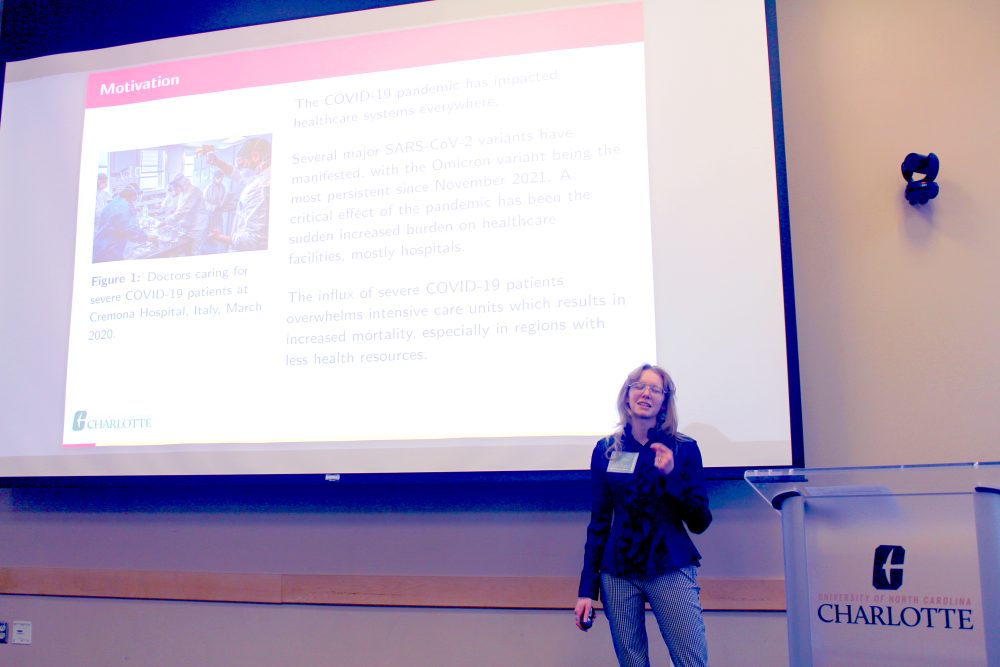
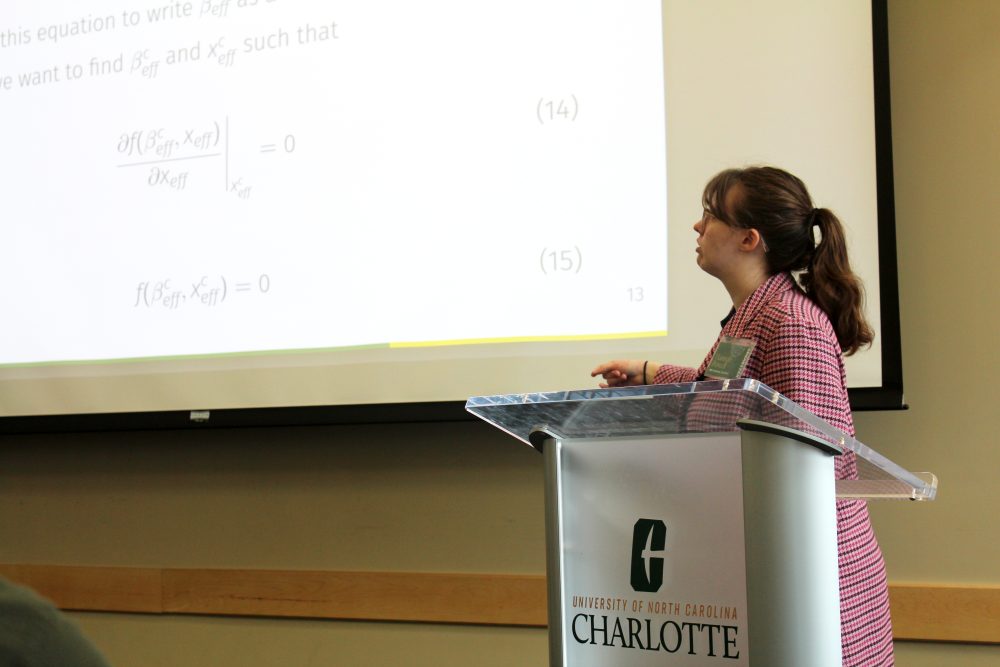
The Mathematics Graduate Student Association (MGSA) hosted the inaugural Graduate Research in Math (GRiM) symposium at UNC Charlotte on Feb. 8, fully planned and executed by and for graduate students.
The Klein College of Science graduate students presented on a variety of mathematical fields, ranging from pure to applied mathematics, and covering topics including graph theory, Ergodic theory, and statistics. Attendees included graduate and undergraduate students and faculty from UNC Charlotte, the University of South Carolina, and Clemson University.
The symposium’s plenary lecture, “On Turing’s formula and the estimation of the missing mass,” was presented by Michael Grabchak, Ph.D., professor of statistics. Grabchak explored how Turing’s formula can give rise to methods for detecting whether two works were written by the same author. Results from this method were shown through examples ranging from Shakespeare to celebrity social media posts.
Sarah Helfert Murphy, graduate assistant in the Department of Mathematics and Statistics, helped to reinstate MGSA as an active campus organization in 2021. “There is no one-size-fits-all formula for getting a Ph.D. in mathematics, so we thought this event would be a nice way to showcase the different forms getting a degree in this field can take,” Murphy said. “I consider it a great success, and we hope to offer this event again next year, and to expand our horizons to invite participants from even more universities.”
Since reactivating MGSA, the organization has offered more events each year for graduate students interested in math. MGSA’s current goal is to offer events that both cultivate a sense of community among graduate students and provide opportunities to grow academically.
“In graduate school, it can be very easy to isolate yourself due to the demanding workload. We seek to mitigate this by encouraging students to talk about math and bond over our shared experience,” Murphy explained. “Our organization also serves to advocate for graduate student interests in the mathematics department.”
Jordan Poler featured in WIRED’s article ‘How to Get PFAS Out of Drinking Water—and Keep It Out’
Jordan Poler, Ph.D., professor in the Department of Chemistry, was featured in WIRED’s article, “How to Get PFAS Out of Drinking Water—and Keep It Out.”
Perfluoroalkyl and polyfluoroalkyl substances (PFAS) are synthetic chemicals found in products like cleaning sprays, nonstick cookware, waterproof clothing and firefighting foam. They are known as “forever chemicals” because they are difficult to break down and can accumulate in the environment and human body.
For decades, the Chemours (formerly DuPont) chemical plant in Cape Fear, North Carolina manufactured these “forever chemicals.” The chemicals ultimately ended up in the Cape Fear River and connected waterways, leading to ongoing lawsuits due to environmental and public health concerns.
“North Carolina’s still dealing with that,” said Poler. “It’s a huge challenge for the people here.”
Filters in water pitchers or under-sink systems can capture PFAS, but are not a permanent solution.
“A lot of these media, you throw them in the landfill and they’re just going to leach everything back out,” Poler explained.
To help solve this problem, the Poler Research Group is pioneering a new PFAS filtration system that is able to suck the chemicals back out of the filter in order to dispose of them safely. This would remove the PFAS permanently, preventing future contamination.
This is critical, as a 2025 study published in the Journal of Exposure Science & Environmental Epidemiology details how residents in areas with high levels of PFAS in the drinking water are already more likely to be diagnosed with certain cancers, including oral, lung and brain cancer.
Susan R. Trammell wins International Patent Award
Susan R. Trammell, Ph.D., professor of physics and optical science, has earned a Prince Mohammad Bin Fahd University (PMU)-National Academy of Inventors (NAI) International Patent Award.
The PMU-NAI International Patent Award recognizes international inventors who create plausibly positive societal impact with an innovation that has received a patent from the United States Patent and Trademark Office within the past 5 years.
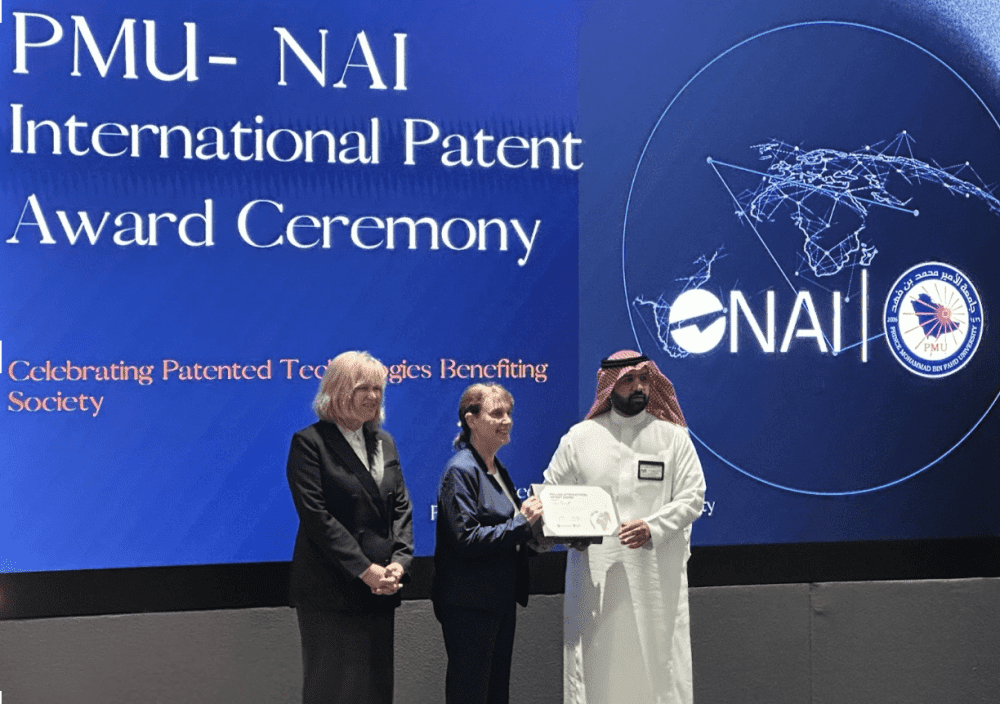
Trammell accepted the award in December 2024 during a ceremony on PMU’s campus in Saudi Arabia. Her third place win included a $10,000 prize to assist in the commercialization of the patent to help bring the technology to market.
Trammell’s research in optics in the Klein College of Science has developed innovations in the fields of biomedical imaging, mid-IR/thermal imaging in medicine, surgical navigation and image-guided surgical interventions.
In 2023, Trammell was recognized as co-author with the Biopreservation and Biobanking Best Paper award from ISBER, the International Society for Biological and Environmental Repositories, for the best paper.
Read more about Trammell’s award from the UNC Charlotte Division of Research.
TAIMING AI and CITRANS leading the way with Charlotte AI Institute
UNC Charlotte announced the formation of the Charlotte AI Institute with the Center for TAIMing AI and the Center for Innovation, Translational Research and Applications of Nanostructured Systems, CITRANS, leading the way.
These two Centers are leveraging the quickly developing field of artificial intelligence to create cutting-edge discovery, interdisciplinary collaboration and workforce development. The Centers are driving innovation along with advanced research from the Klein College of Science in biological sciences, physics and optics, chemistry, and mathematics and statistics.
Faculty in Klein College also make important research contributions to CIPHER, the Center for Computational Intelligence to Predict Health & Environmental Risks.
Read more about the Charlotte AI Institute.
Klein College of Science Centers leveraging AI

KCOS researchers Afonin and Johnson in Newswise: Reimagining Personalized Medicine with AI-Cell
Kirill Afonin, Ph.D., professor of chemistry, and M. Brittany Johnson, Ph.D., assistant professor of biology, were featured in Newswise for their research on nucleic acid nanoparticles (NANPs), which are highly effective in drug or vaccine delivery.
The Klein College of Science researchers, along with Drs. Dobrovolskaia’s (NCI) and Zakharov’s (NCATS) teams, have developed new applications for Artificial Intelligence Cells. AI-Cell uses artificial intelligence to quickly select the appropriately shaped nanoparticles that can deliver targeted treatments personalized to an individual’s DNA.
“If designed correctly, your body will recognize these artificially made NANPs as its own components, which can initiate and guide various biochemical processes and help fix the problem from within,” Afonin said. “The big idea is to develop a biomolecular language to explain to our bodies and immune system how to reveal and deal with certain diseases – and make this technology user-friendly, widely available, personalized, and affordable.”
The NANPs can fold in specific, predictable ways, and quickly selecting the correct shape to generate the intended immune response helps target the therapy to the precise location.
“The immune system is a very complex process,” Johnson said. “A lot of times we think the immune response is always productive. In reality, it’s a little bit more like a see-saw and you want things to be in balance.”
“You need peaks at certain times… and you want that immune response to have certain qualities. And then you want that to resolve so that you can go through a healing process,” Johnson said. “You have to be cautious because you could stimulate an unwanted immune response.”
Jordan Poler featured on WBTV for PFAS Filter Innovations
Jordan C. Poler, Ph.D., professor of chemistry, was featured as the cover story on WBTV’s “On Your Side Tonight” to discuss his innovations on filtering forever chemicals from water supplies with a purification method he designed.
Poler spoke with reporter Natisha Lance to explain how his innovation, funded last year as one of eight grants statewide from NCInnovation, uses sustainable and low-cost materials to remove contaminants and chemicals such as per- and polyfluoroalkyl substances, PFAS, from water.
The filters can be regenerated nearly indefinitely, which allows for the chemicals to be removed without concentrating them elsewhere by disposing of the filter.

“What you’ve done is you’ve concentrated all the impurities onto that filter and then you put it into the landfill and all those impurities leach back out,” Poler said. Poler’s innovation allows the filter contents to be regenerated and used again. “We can keep on going for hundreds of cycles without any loss in performance so it’s a sustainable solution to a really difficult environmental problem.”
Poler has engaged in this research for eight years and is hoping to be able to bring the sustainable water filter to the market within a year.
“We don’t have to create an environmental problem while we’re trying to solve an environmental problem,” said Poler. “It’s really rewarding working on something that could have a direct impact on people.”
Elizabeth Skelly secures prestigious GSK internship
Elizabeth Skelly, a Ph.D. student in the Chemistry and Nanoscale Science program, has received a 5-month internship at GSK through the prestigious GSK Early Career Program. Skelly will start her position on January 13 and will be assisting in drug target discovery and candidate evaluation using cutting-edge CRISPR Cas 9 genome editing techniques.
Skelly is also the recipient of the Leadership Development Award from the American Chemical Society Younger Chemists Committee. The award covers the registration fee, transportation, lodging, and meals associated with attending the 2025 ACS Leadership Development Institute in Houston. Skelly will interact with National ACS representatives and with ACS Local Section leaders from across the country while attending leadership development workshops.
Jordan Poler’s research on water filtration and removing PFAS highlighted
Jordan C. Poler, Ph.D., professor of chemistry, discussed his innovations to remove harmful and forever chemicals from drinking water with the Costal Review. Poler’s research is funded in part by a grant from NC Innovation.
The purification system developed by the Poler Research Group cleans per- and polyfluoroalkyl substances, or PFAS, and other toxins such as pesticides, heavy metals and pharmaceuticals from drinking water at the point of use, such as the refrigerator filter for tap water or in well water systems. The filtration utilizes ion exchange with sustainable, regenerable materials, which can remove chemicals even at very low concentrations.
“It’s very hard to remove things at extremely low concentrations,” Poler said. “That’s why PFAS is such a challenge because it bioaccumulates. You can be drinking this water for years and then these problems creep in. So, ion exchange is, I think, the way to go,” Poler said.
Read the full article at the Coastal Review.
The article was also republished in NC Health News.
Ishwar D. Aggarwal elected as National Academy of Inventors Fellow
Ishwar D. Aggarwal, Ph.D., research professor in the Klein College of Science, was elected to the National Academy of Inventors (NAI) 2024 Class of Fellows. He will be inducted during the 14th annual NAI meeting in June 2025 among an elite group of researchers across a variety of government and non-profit research institutions.
Aggarwal has been issued 104 U.S. patents with more applications in process. He previously lead the Optical Materials and Devices branch at the Naval Research Laboratory (NRL), where he pioneered the development, applications and commercialization of infrared transmitting optical materials, chem-bio sensors and high strength transparent materials, and moved patents from emerging technologies to the industrial sector in medical, defense, and aerospace applications.
Aggarwal joined UNC Charlotte in 2011 and his research lab in the Department of Physics and Optical Science works in fiber optics, optical wave guides, fiber devices, and transparent and laser gain ceramics.
His contributions to the optical sciences field have been recognized by many awards and distinctions, including a fellow of The Optical Society of America (OSA), now known as Optica, the Navy’s Alan Berman Publication Award, the Thomas A. Edison Patent Award, and the Optical Society of America’s David Richardson Medal. He was recently inducted into UNC Charlotte’s inaugural Million Dollar Research Circle for his significant research funding achievements.
The NAI Fellowship is the highest professional distinction awarded solely to inventors, and Aggarwal is the first UNC Charlotte professor to receive this esteemed recognition. He joins NAI fellow Robert Keynton, Ph.D., dean of the William States Lee College of Engineering, who was elected in 2017, prior to his time at UNC Charlotte.
Read more about Aggarwal’s fellowship from the UNC Charlotte Division of Research.