A Tale of Two Titans
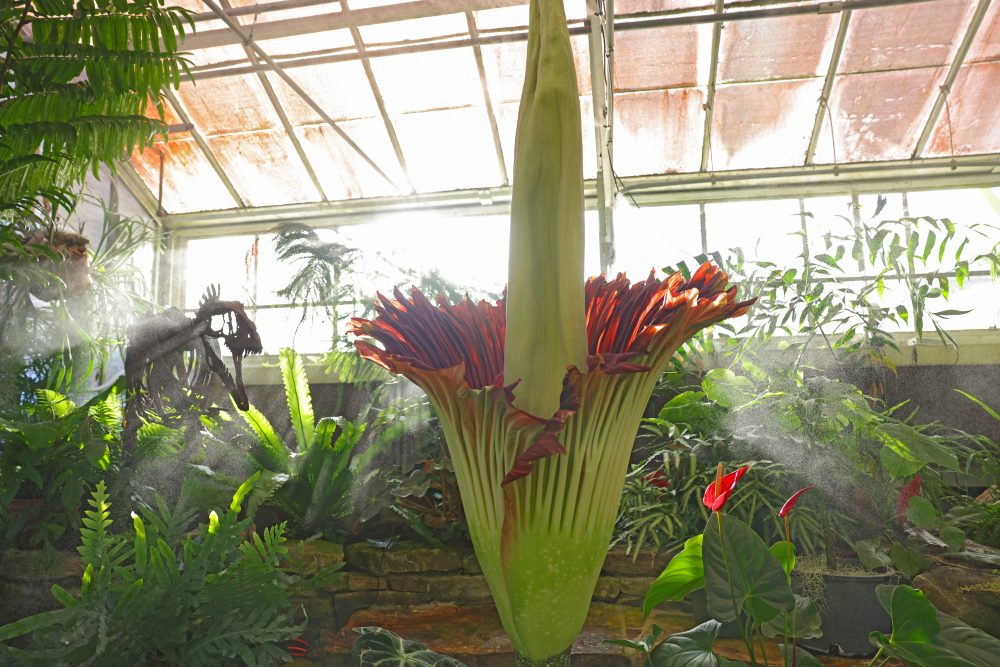
Corpse flowers in the UNC Charlotte Botanical Gardens draw crowds and advance research in the world’s largest inflorescence
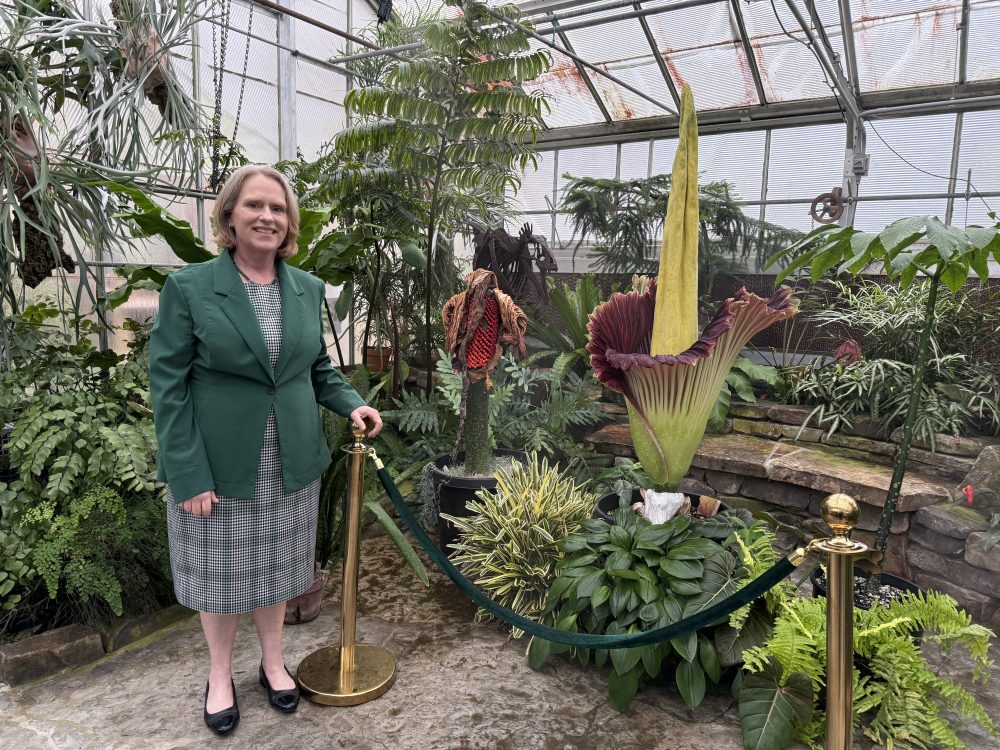
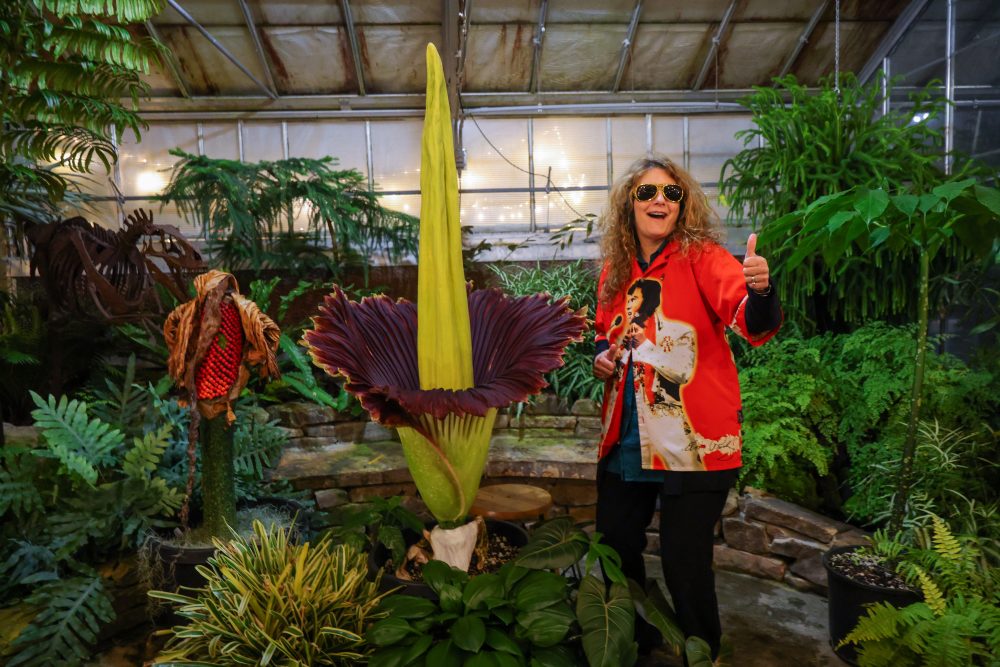
The UNC Charlotte Botanical Gardens marked a milestone season as two titan arums bloomed in succession, drawing thousands of visitors and offering researchers in the Klein College of Science a rare chance to study one of the world’s most unusual plants.
The back‑to‑back blooms of Cadavera and Smellvis mark the latest chapter in more than 20 years of history of corpse flower cultivation at UNC Charlotte, with nine total blooms across six plants.
The titan arum, or Amorphophallus titanum, is known for its towering height, dramatic bloom cycle growing as much as four inches a day, and pungent odor that has earned it the nickname “corpse flower.” It is native to the island of Sumatra in Indonesia and is endangered, with cultivation in greenhouses across the world and a network of supportive gardens propagating for the future success of this rare plant.
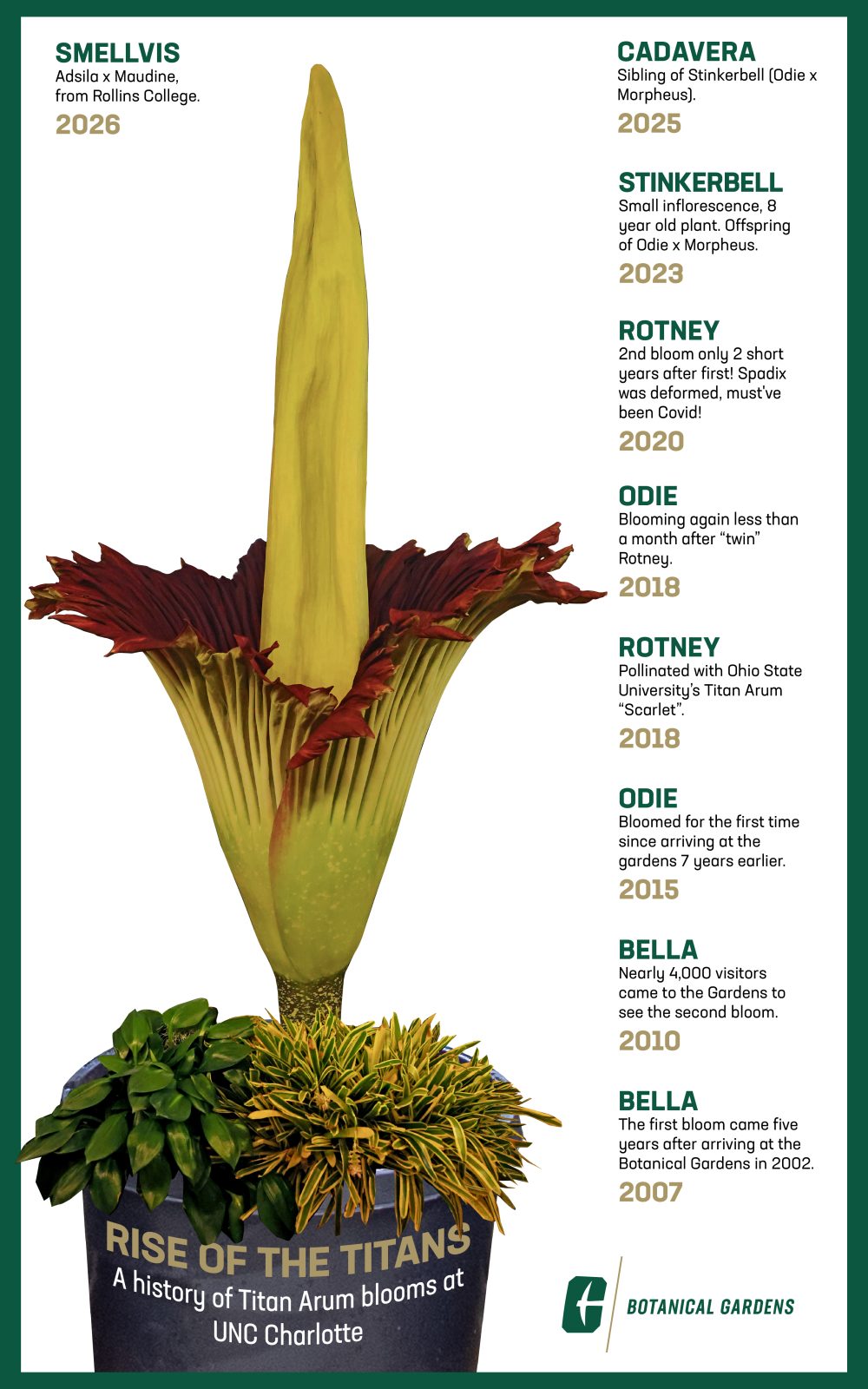
UNC Charlotte cultivates the species from seed, and hosted the first titan arum bloom in the Carolinas in 2007. The program was started by Larry Mellichamp, a former longtime director of the Botanical Gardens, when he purchased a specimen of titan in the 1990s. That first titan died in a cold snap before it bloomed, making Mellichamp determined to cultivate the difficult to grow species at UNC Charlotte.
“Every bloom feels like a small miracle. Titan arums are endangered in the wild, so each successful flowering here is both a celebration and a reminder of why conservation work matters,” said Tammy Blume, assistant director of the Botanical Gardens.
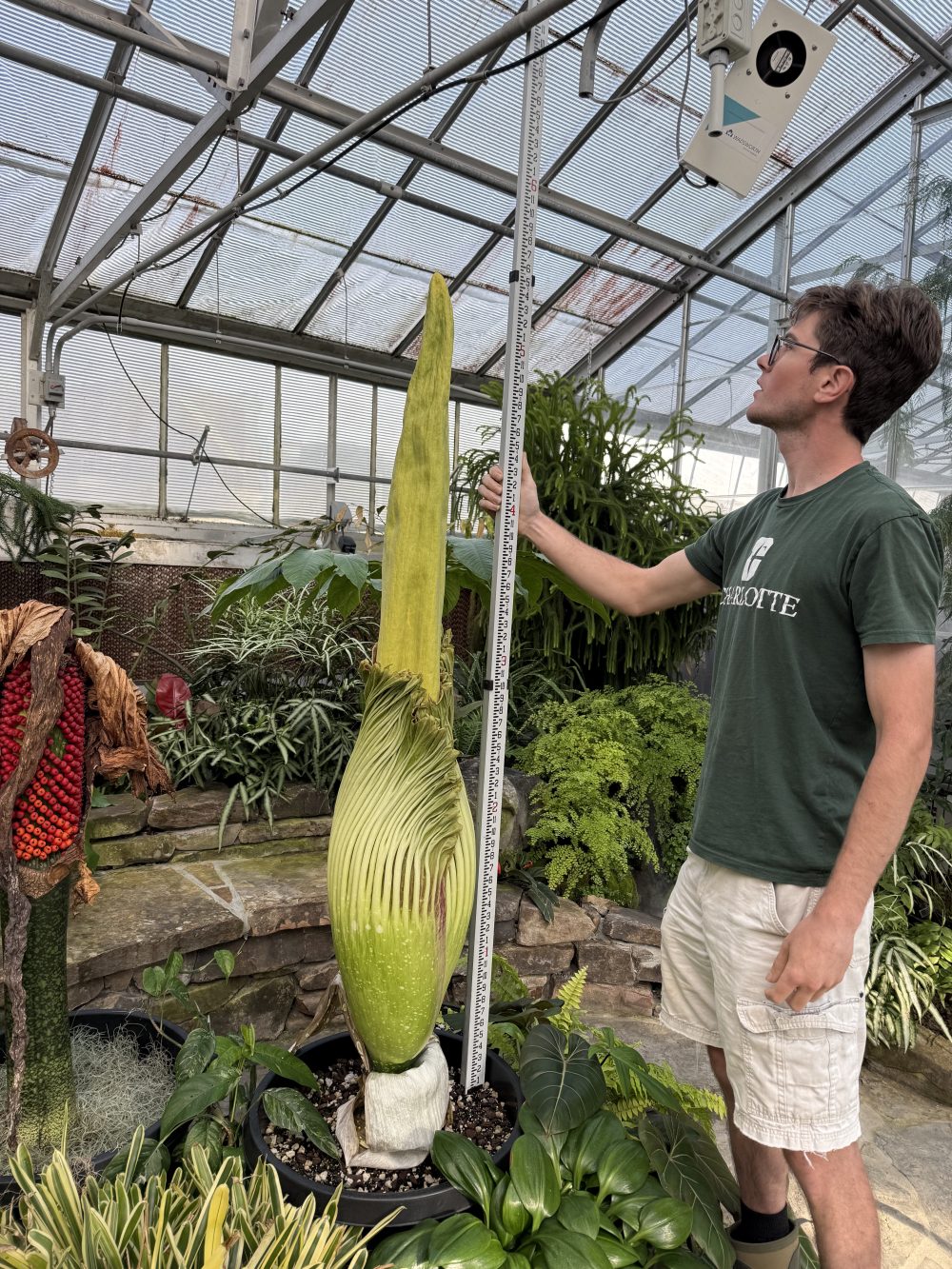
| Cadavera | Smellvis |
| Opened Oct. 1, 2025 | Opened April 27, 2026 |
| Age at first bloom: 10 years old | Age at first bloom: 10 years old |
| Sibling to Stinkerbell, which bloomed at age 7 in 2023 | Seed sourced from Rollins College, pollinated from Ohio State University |
| Height at bloom: 77 inches (largest ever at UNC Charlotte) | Height at bloom: 64 inches |
Cadavera: A Community Event With Thousands in Attendance
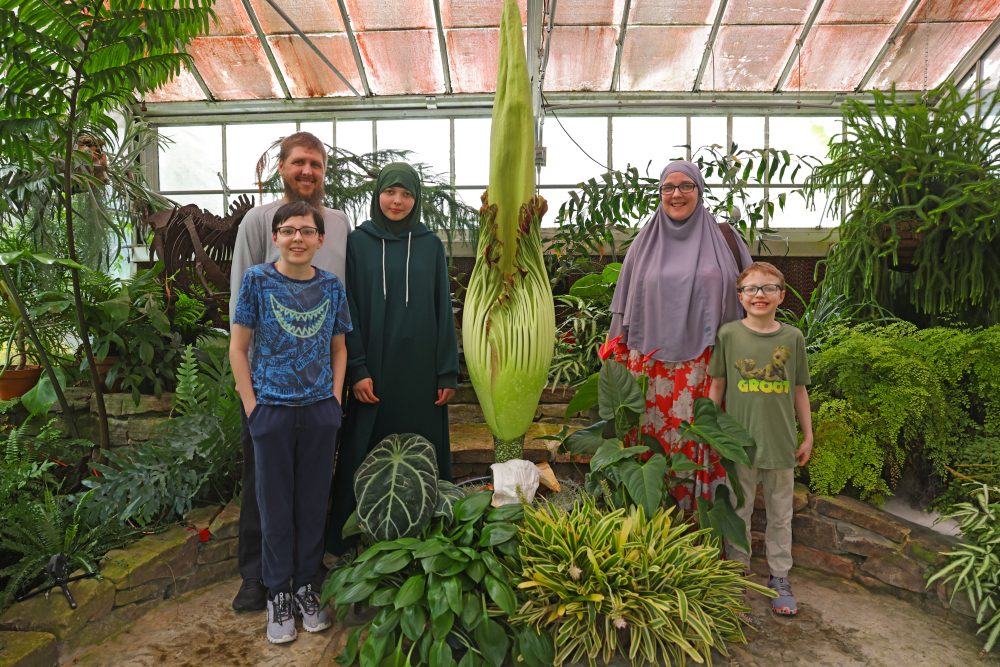
Cadavera’s first bloom transformed the McMillan Greenhouse into a destination, attracting more than 7,500 in‑person visitors and over 10,000 livestream viewers during its brief blooming life cycle.
Crowds lined up behind the green velvet rope in the Dinosaur Room, some waiting more than two hours for the chance to see (and smell!) the rare inflorescence. Families, students, alumni and plant enthusiasts from hours away bought stickers as mementos and filled the greenhouse throughout the day and late into the night as staff extended hours to accommodate demand.
The visitors were jovial and many people chatted and made friends in line with other bloom watchers, as they worked their way from the end of the line at Fretwell, down Mary Alexander Road, up Craver, and into the Greenhouse. Charlotte-Mecklenburg schools were out the following day for a teacher workday, so families stayed up past bedtimes and children played on the hill until it was their turn to visit Cadavera.
“We’ve spent decades nurturing these plants from seed, watching them leaf out year after year until one day the bud looks just a little different,” said Blume. “When Cadavera finally opened, seeing thousands of people line up to experience it reminded us why we do this work. It’s not just a flower to see, it’s a flower to experience.”
Cadavera, grown from seed in 2015, is the offspring of Odie, a previous UNC Charlotte titan arum, and Morpheous from the Daniel Stowe Conservancy. Its bloom continues a lineage that includes Bella (2007, 2010), Odie (2015), Rotney (2018, 2020), Stinkerbell (2023).
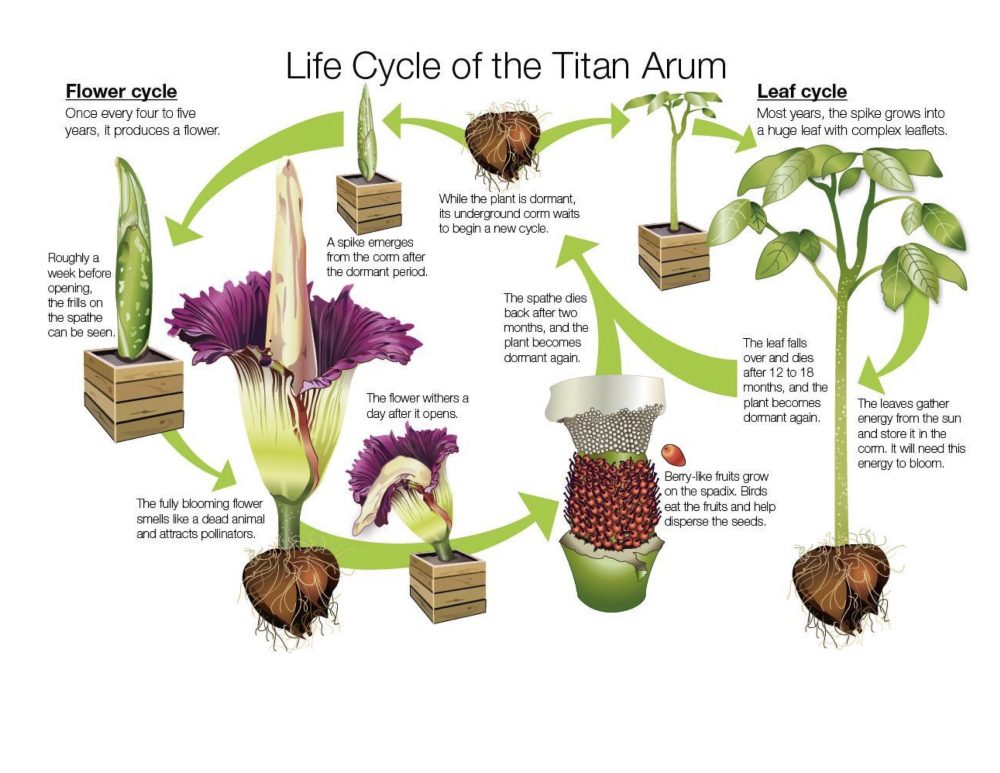
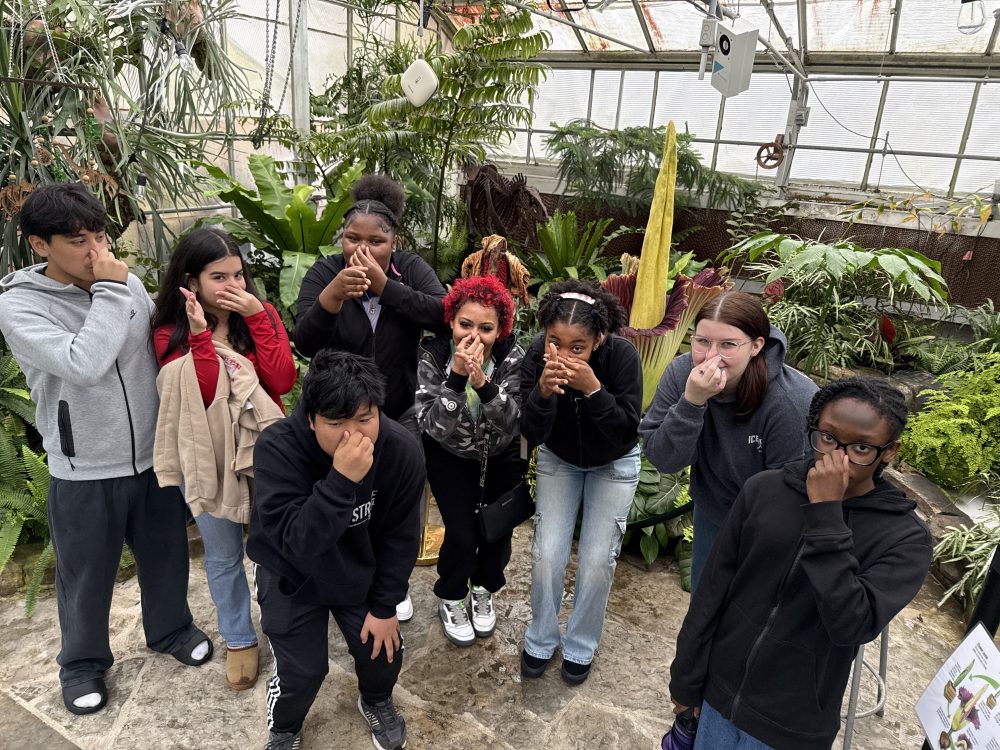
Visitors described the experience as unforgettable. From the towering height of the plant to the unmistakable scent, being in the presence of a titan arum in bloom is a memorable experience. The smell emitted during a bloom is often compared to rotting meat, a natural strategy to attract pollinators such as beetles and flies.
“You absolutely have to experience the smell at least once,” said Mariah Huffman, director of education and engagement of the Botanical Gardens. “It’s disgusting in the most fascinating way, and you’ll carry the smell with you when you leave. People at home will wonder why they didn’t come along. It turns a single bloom into an adventure you talk about for years.”
Smellvis: A Scientific Opportunity for Heat Imaging and Pollination Research
While Cadavera captured the public’s attention, Smellvis offered researchers another rare chance to study the titan arum’s biology. Chemists from the Klein College of Science collected samples from Cadavera, and hatched new hypotheses and planned different experiments for the next titan bloom, without knowing it would come so soon.
Botanical Gardens staff completed a full pollination cycle. Smellvis was pollinated using pollen previously collected from Cadavera, stored in a –80°C deep freeze to preserve viability.
On the second day after Smellvis opened, staff collected fresh pollen and returned it to deep freeze storage, ensuring material from a different lineage is available for future blooms.
“When people step into the greenhouse, they’re stepping into the world,” said Huffman. “A titan arum sparks so many questions — ‘Where does it grow?’ and ‘Why does it smell like that?’ — and suddenly we’re talking about Sumatra, leaf cycles, and what it really means to be a flower. Watching that curiosity ignite is my favorite part of this job.”
As the 10‑year‑old plant was growing quickly, researchers from the Aggarwal Department of Physics and Optical Science loaned an infrared thermal camera to the chemists to monitor the spadix — the central column of the bloom — during thermogenesis. The spadix naturally heats up as the flower opens, helping disperse its scent to attract pollinators.
The thermal imaging allowed scientists to observe temperature changes minute by minute, providing new insight into the timing and intensity of the heat surge that accompanies the bloom.
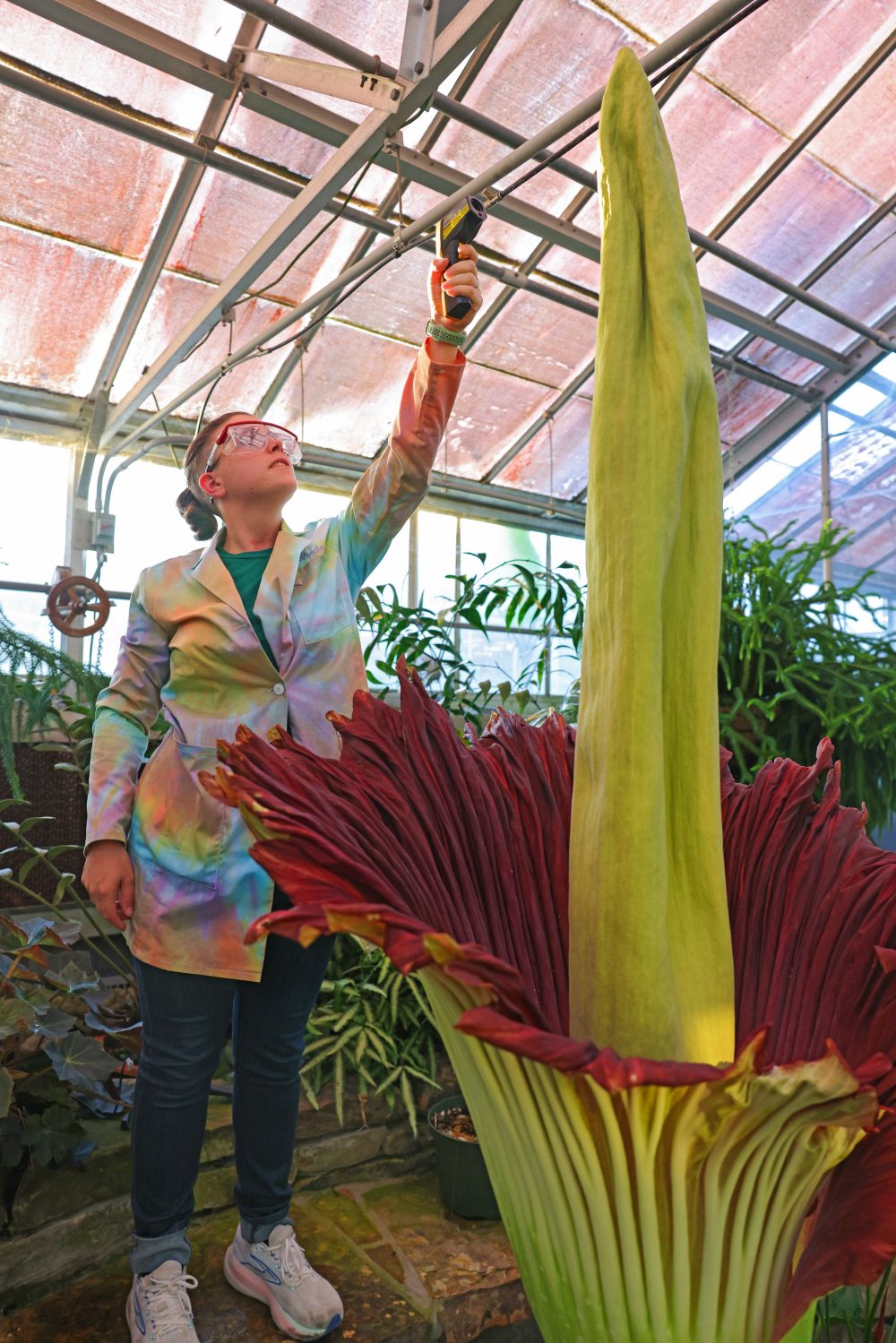
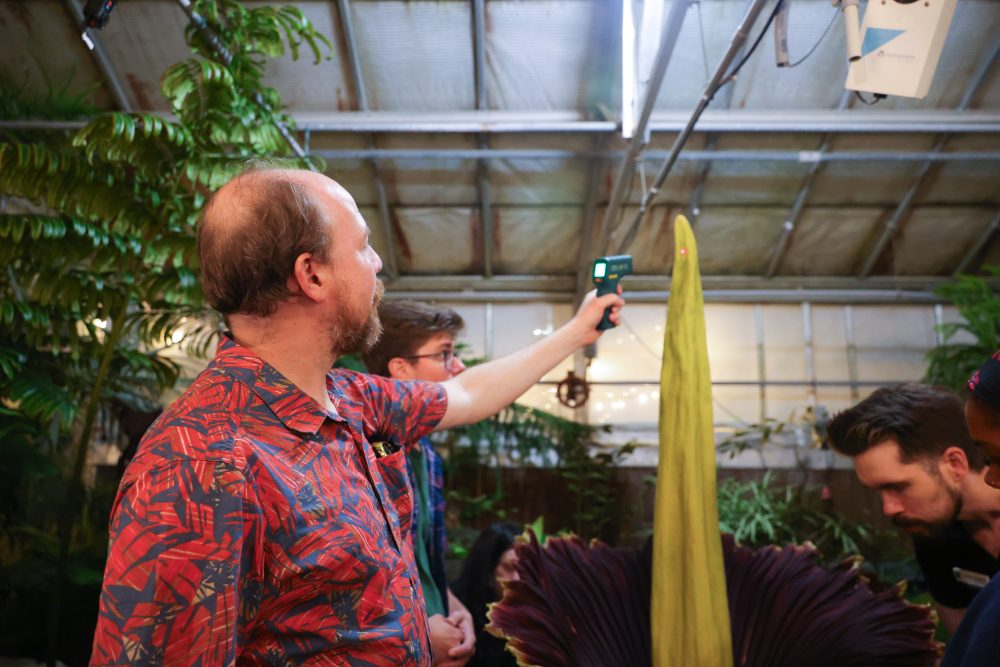
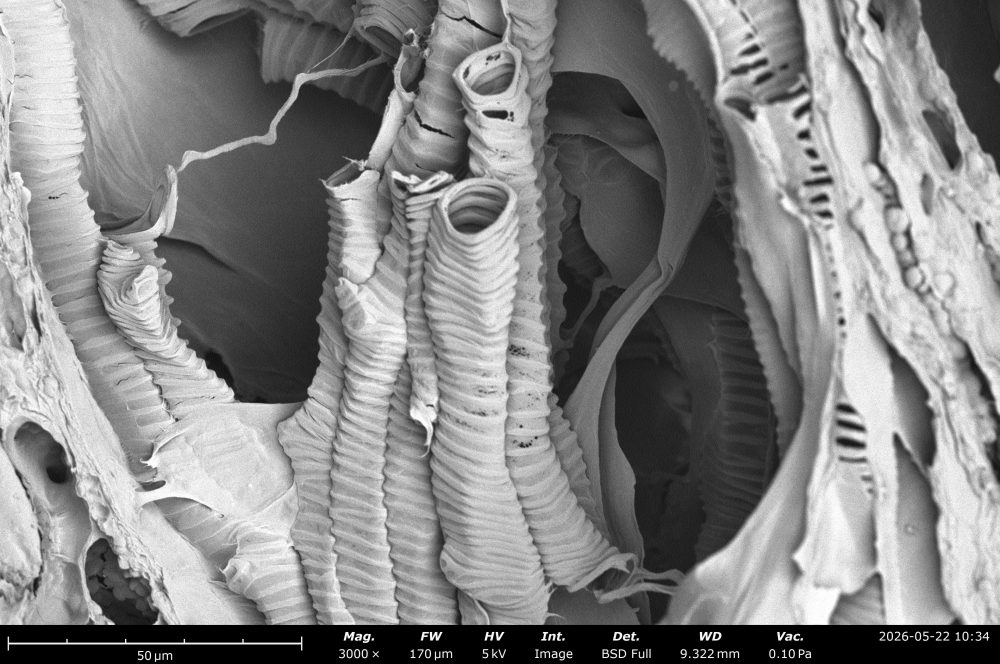
Lauren Woods and Jacob Horger, faculty from the Klein College of Science Department of Chemistry, took samples sputter coated in gold by the William States Lee College of Engineering, and examined them through the Scanning Electron Microscope (SEM).
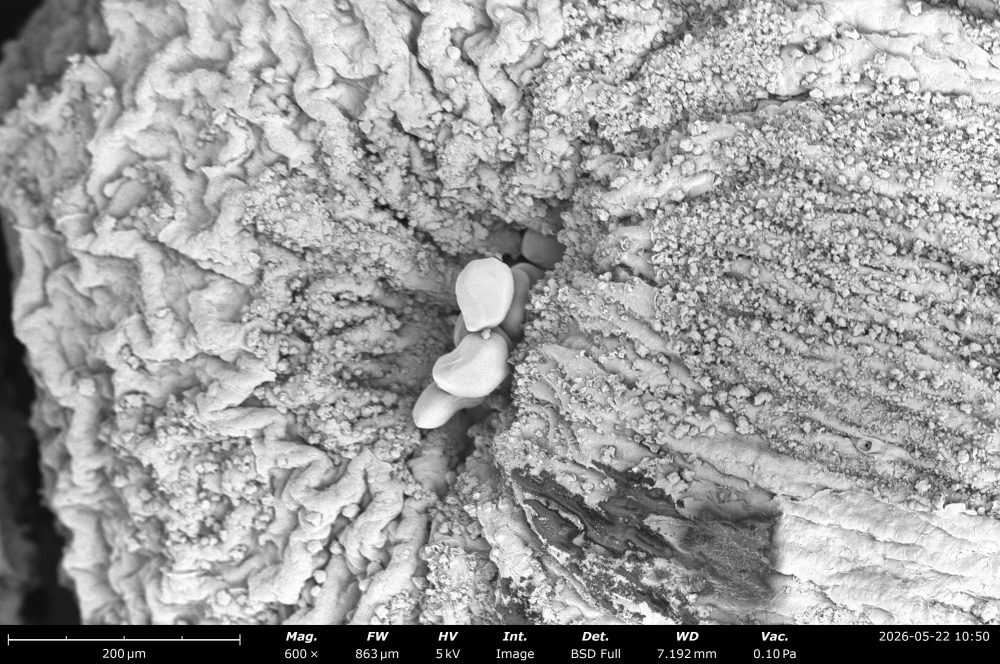
Images from the SEM reveal the wonders of a microscopic world inside the giant titan.
With a 600x magnification on the stamen, the pollen is visible emerging from the anther, ready to be picked up by an insect, or in the controlled environment inside the McMillan Greenhouse, a human collector.
Under a 3000x magnification, the pollen tubes in the stylus allow the pollen to travel to the ovaries.
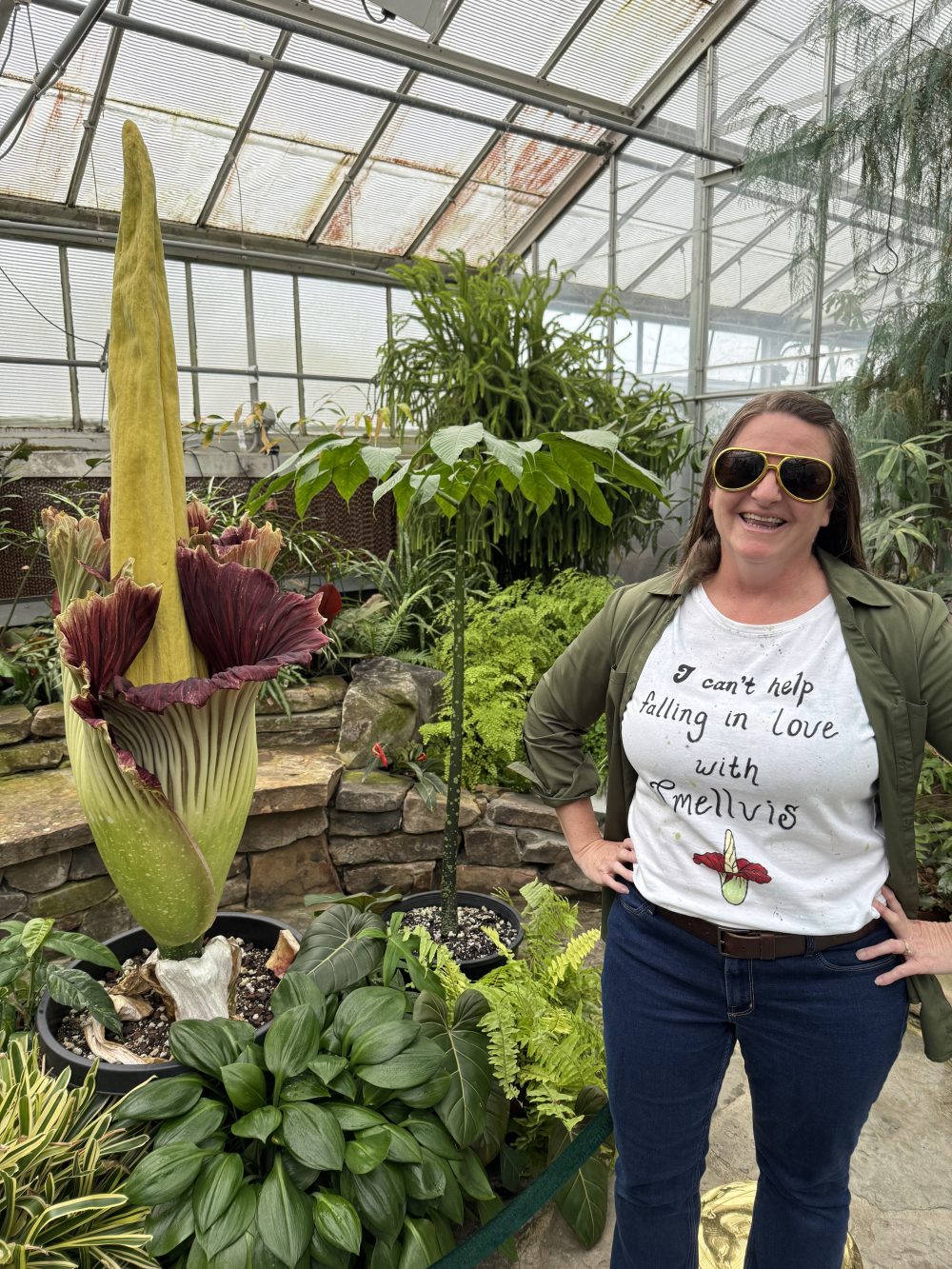
Smellvis, planted in 2016 from seeds sourced through Rollins College, is the offspring of Adsila (Rollins College) and Maudine (Ohio State University). Its bloom continues the gardens’ tradition of naming each titan arum at its first inflorescence, with “Smellvis” voted on by the team from the Botanical Gardens from more than 150 public suggestions submitted through social media.
Betsy Arndt suggested the name Smellvis as she shares a birthday with its famous namesake. She also visited Cadavera during its bloom and stood in line with the family that named Cadavera, inspiring her to enter the naming contest for the next bloom.
A Legacy of Blooms and a Growing Public Following
The back‑to‑back blooms of Cadavera and Smellvis underscore UNC Charlotte’s role as a regional leader in titan arum cultivation, public engagement and scientific study. From the first bloom in 2007 to today’s research‑driven approach, the Botanical Gardens continue to blend community excitement with conservation‑focused work.
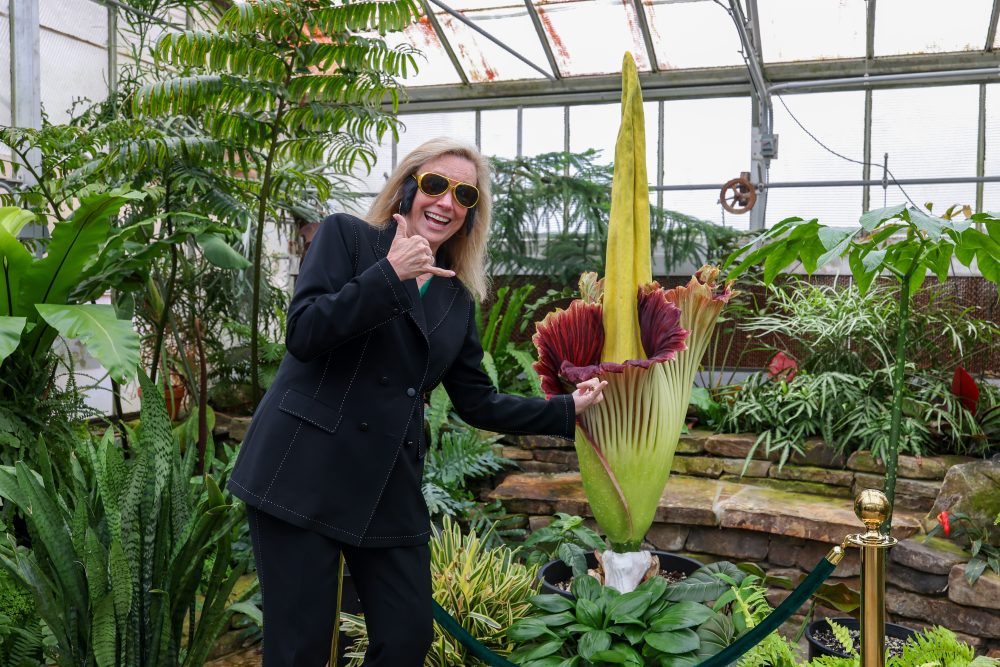
“Smellvis is my seventh corpse flower bloom. My first was Odie in 2015, back when I was a biology student and a student worker in the greenhouse,” said Huffman. “I’ve been caring for these plants ever since, and I plan to pollinate and share many more blooms in the years ahead.”
How to Visit
Visitors can view Smellvis, Cadavera, their sibling plants and many other species from around the world inside the McMillan Greenhouse, located at 9026 Craver Rd. on the main UNC Charlotte campus.
The Botanical Gardens are open from sunrise to sunset, 365 days a year. The McMillan Greenhouse is open to the public 9 a.m. to 4 p.m. on weekdays.
Admission is free.
- Written by Jenn Conway
- Photography by Kat Lawrence
- Video content and editing by Jenn Conway
- SEM images by Lauren Woods and Jacob Horger, Department of Chemistry. SEM images were acquired on a Thermo-Fisher Phenom XL G2 SEM at 5kV accelerating voltage using the backscattered electron detector
- Smellvis time lapse footage by Harrison Hieb
- Titan arum timeline graphic by Ngoc Le and Ryan Honeyman
- Live bloom streams by Hank Silver II
- Thermal Video edited by Nick Woods
- Infrared camera courtesy of Thomas Hutchens, Aggarwal Department of Physics and Optical Science