Ecology Study Discovers City is an “Uber-Forest” for Big Barred Owls
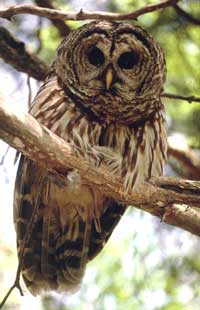
It may be news to its bankers, but Charlotte, the biggest city in North Carolina and a major center of the American financial industry, is actually an old growth forest.
At least that’s the way the barred owls see it.
Charlotte is famous for having two kinds of green. It is home to two of the nation’s largest banks and its downtown residential neighborhoods and near-suburbs are also known for their lush yards and green streets, lined with large trees. Less well-known is the fact that the city is almost as well populated with large owls – particularly barred owls – as it is with bankers. Harry Potter would feel very much at home.
In fact, the barred owl population in Charlotte is so strong that the city was chosen to be the site for the most extensive barred owl research study that has ever been attempted, with fieldwork going on in the manicured front lawns and gardened back yards of urban and suburban neighborhoods.
Urban wildlife numbers have been increasing in recent decades, notably in populations of squirrels, Canada geese, raccoons and deer, but the appearance of significant urban populations of barred owls, the third largest owl species in the United States, is a surprise to many biologists.
“If you read about barred owls in the textbooks, it says they need large stands of old-growth forest to survive,” notes ecologist and ornithologist Rob Bierregaard of The University of North Carolina at Charlotte, who has directed the six-year-old research study. “Either the barred owls in Charlotte haven’t read that book or the book is wrong, because they are really here and apparently doing quite well.