College Names Diverse Group As CLASS-ACT Team
Six UNC Charlotte students from varied backgrounds will act as student advisors to the Dean’s Office in the College of Liberal Arts & Sciences, drawing from their experiences with their studies, internships, and leadership positions. The students are part of CLASS-ACT (CLAS Students – giving Advice, making Connections, receiving Training), an undergraduate student advisory council in the college.
Stephanie Mims is a sophomore majoring in Mathematics for Business with a concentration in Actuarial Science and a minor in Computer Science. She just recently completed an internship with the reinsurance company SCOR and said she hopes to apply the presentation, professional, and communication skills learned during this internship to the CLASS-ACT program.
Mims’ interest in CLASS-ACT was sparked by the opportunity to voice her opinion and make positive changes that will benefit the college. She said she would like to inform future students why CLAS is an exciting college that holds a wide variety of career paths. Mims hopes to impact the SOAR orientation program and to bring professors together with students for a more connected environment. Personally, Mims hopes to gain even more leadership, project development, presentation, and professional skills.
Ryan Gobble is a senior double majoring in Political Science and Sociology. In coordination with University College, Communication Across the Curriculum, and the University Writing Center, he serves as the discipline communication consultant for the Sociology Department. Gobble enjoys helping students enhance their writing skills and effectively express their own thoughts and ideas. His research interests include social stratification, the dynamics of racial inequality, deviance, law, and social control.
When not at school or working, Gobble enjoys learning more about nutrition and maintaining an active lifestyle. Following graduation, he plans to continue his studies and to pursue a career in law. Through the CLASS-ACT Student Advisory Group he hopes to serve as a leader within the college while contributing new insights that work towards the betterment and growth of the College.
Kevin Caldwell, a senior in the Department of Religious Studies, has participated in two summers of archaeological field work in Jerusalem, where he was a staff member of the Mt. Zion excavation. He is currently working on a project with the Levine Museum of the New South that examines redevelopment in the Historic West End. A Charlotte native, Caldwell said he is excited at the prospect of graduating and giving back to the community that has shaped him.
In his spare time, Caldwell enjoys cooking, woodworking and any outdoor activities. He also participates in a mentorship program at James Martin Middle School, where he mentors students in the establishment of a student government assembly. Caldwell is a member of the second class of scholars of the Levine Scholars Program.
Laura Eason is a junior at UNC Charlotte. She is an English major with a concentration in Language and Digital Technology with a minor in Communication Studies. Eason is a member of Sigma Tau Delta and the English Honor Society. Eason completed the Women’s Leadership development program at UNC Charlotte, and currently balances work between the Niner Times and a wedding coordinating internship. In her free time, she enjoys finding interesting new places, passing time with friends, writing, traveling, and catching up on the latest hit TV shows.
Eason expressed excitement to be a member of CLASS-ACT, and through this experience, she hopes to learn more about the community, the university, and the people here. She is exploring her future career plans.
Denise Jackson is majoring in Sociology and German, and expects to graduate in May 2015. She holds an associate’s degree in baking and pastry arts from Johnson & Wales University. Jackson volunteers for the Leadership Committee of the American Council on Germany, assisting them at ACG events. She works with the Honorary Consul of the Federal Republic of Germany in Charlotte coordinating his events, specifically his Transatlantic Exhibition of Art in the Southeast that is taking place in September.
As part of the 2014-2015 CLASS ACT Student Advisory Council, Jackson seeks to develop her leadership skills. She wants to be an example for young adults, specifically those with children, so they can see that anything is possible and that while sacrifice is necessary, things will get less difficult as time progresses.
Bryanna Sierra is double majoring in Chemistry and Biology. After graduation she plans to continue her education and enroll in a dual M.D. /Ph.D. program. Sierra works in Didier Dréau’s lab, focusing on metastases associated with cancers of epithelial origin. She is also a member of the National Society of Collegiate Scholars and Sigma Alpha Lambda.
Sierra looks forward to completing the largest leadership program at UNC Charlotte, PILOT. She said she is convinced that the leadership skills taught in this program can be applied to most aspects of her life, specifically her opportunity at UNC Charlotte as a TASL learning coach. As a TASL learning coach, she works with students in chemistry workshops to encourage them to apply and master material presented in the lecture. When not studying or working in the lab, Sierra enjoys swimming and running.
Words by Tyler Harris, Student Communications Assistant
Glenn Boreman, Physics and Optical Science Chair, Elected to SPIE Leadership
Glenn Boreman, who is the chair of the Department of Physics and Optical Science at UNC Charlotte, has been named the 2015 vice president of SPIE, the international society for optics and photonics, with his term beginning Jan. 1, 2015.
Boreman also is director of UNC Charlotte’s Center for Optoelectronics and Optical Communications and co-founder and chairman of the board of Plasmonics, Inc. His research interests include Infrared detectors and systems, infrared antennas and frequency-selective surfaces, image-quality characterization, and modulation transfer function.
SPIE 2014 President Philip Stahl announced election results on August 19 at the annual general meeting of the society. Boreman joins the SPIE presidential chain and will serve as president-elect in 2016 and as the society’s prresident in 2017.
Boreman has served on SPIE planning committees, is a long-time instructor of the course “Basic Optics for Engineers,” and is the author of the SPIE Press book Basic Electro-Optics for Electrical Engineers. He is coauthor of the graduate textbook Infrared Detectors and Systems and author of Modulation Transfer Function in Optical & Electro-Optical Systems. He has published more than 100 articles in the areas of infrared detector and focal-plane analysis, optics of random media, infrared scene projection, and transfer-function techniques.
Boreman received his bachelor’s degree in optics from the University of Rochester, and his Ph.D. in optics from the University of Arizona. He has been a visiting scholar at Imperial College in London, Swiss Federal Institute of Technology (ETH) in Zürich, Universidad Complutense in Madrid, and the Defense Research Agency (FOI) in Linköping, Sweden.
He is a fellow of SPIE, the Optical Society of America, and the Military Sensing Symposia.
Biology Major Overcomes Obstacles; Earns GSK Opportunity Scholarship
By Brittany Algiere
Student Communications Assistant
CLAS Communications and Marketing Office
UNC Charlotte biology major Kayla Kinard has defeated struggles and overcome obstacles that could have stopped her in her mission for an education. Instead, she has found her efforts rewarded with one of six GSK Opportunity Scholarships, awarded to students who have conquered adversity to pursue education.
“It is strength of character that allows a person to overcome significant adversity and hardship,” Daniel Troy, GSK senior vice president and general counsel, wrote. “It is often coupled with a decision not to allow circumstances beyond our control to define who we are – or what we will do with our lives.”
Kinard described herself as humbled, grateful and amazed by her award. “I get to follow my dreams and continue my education,” she said. “I won’t have to worry about paying out of pocket, at least for now.”
Throughout Kinard’s senior year of high school, her mother, Tesca Kinard, was in and out of the hospital struggling with chronic heart failure that had troubled her throughout Kinard’s life. Tesca Kinard’s heart even stopped before her daughter could leave the house on prom night, turning the special night into a tragedy. Kinard performed CPR and went with her mother to the hospital. She took prom pictures in the hospital that night, before attending prom at her mother’s urgency.
Despite the struggles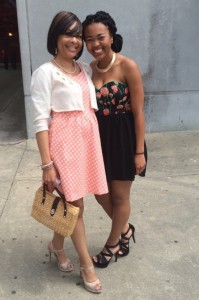 , Kinard never quit. While caring for her mother and managing household demands, Kinard worked two jobs outside the home and held leadership positions such as class president each of her four years in high school. She graduated second in her class, with a 4.4 grade point average. When Kinard spoke at her high school graduation, her mother watched online, unable to attend.
“Not having my mother physically there for big events in my life, such as prom and graduation, was very difficult,” Kinard said. “It was hard. I didn’t want to go to school, but my mother kept pushing me to go and pretend like everything was OK. I had so many unexcused absences that I almost went to truancy court. In my eyes, giving up was an option, but not in my mother’s.”
Kinard now is a sophomore at UNC Charlotte focused on her studies, while also working as a communications assistant for the College of Liberal Arts & Sciences’ communications and marketing office. She is thinking about becoming a doctor or dentist, feeling a strong desire to help others by pursuing a medical career.
“I’m leaning more towards dentistry,” she said. “I’m enjoying the college experience at UNC Charlotte. I’m really thankful for my mother and Ms. Godwin, who was a teacher and a family friend, for making me stay focused, putting my education first, and guiding me down the right path.”
Photos courtesy of Kayla Kinard
New UNC Charlotte Garden to Showcase Native Flora, Sustainable Practices
A new garden in the works at UNC Charlotte Botanical Gardens will blend southeastern native flora, sustainable practices, and smart home landscape design in a 1/5-acre showplace that will add to the diversity of these public gardens.
The design for the Mellichamp Native Terrace Garden artfully combines common home landscape features – wooden and stone terraces, low stone walls, gravel paths and a dry/storm water-fed streambed. The garden will showcase a variety of native plants that fill common landscape needs, such as for groundcovers, specimen plants, flower borders, privacy hedges, and foundation plantings.
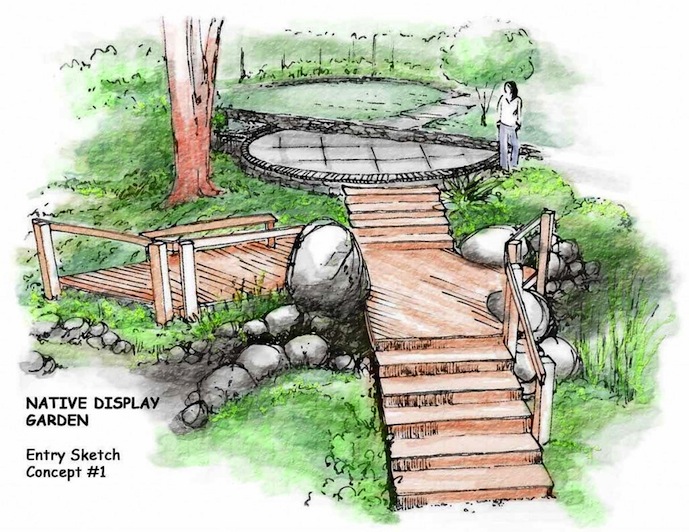 It also will feature a rain garden, native lawn and lawn substitutes and a mini-meadow planting. The vision for this garden is to inspire and inform visitors about the beauty, horticultural utility, and sustainability of the southeastern flora.
Edward Davis, Landscape Architect is developing the initial concept into a coherent and integrated design. The project is currently under construction and will be substantially complete by the end of 2014 — funding permitting. Funding this far for this project includes grants from the Stanley Smith Horticultural Trust, the North Carolina Native Plant Society, private donors, and the College of Liberal Arts & Sciences. The Botanical Gardens seeks additional funds to complete the project.
The Botanical Gardens promote the knowledge and appreciation of plants for educational, environmental, and aesthetic purposes. It offers community classes, opportunities for a relaxing stroll through a beautiful setting, information for people studying plants and those seeking knowledge on the variety of plants the area’s climate can support, plant sales and other resources.
Very few UNC Charlotte faculty members can say they will celebrate their retirement by having an entire garden named after them – but Larry Mellichamp will when he finally goes into the full bloom of retirement at the end of 2014.
Dr. M., as he is affectionately known by many of his former students, colleagues, alumni and community friends, has been director of the UNC Charlotte Botanical Gardens and professor in the Department of Biological Sciences for nearly four decades. His legacy will be honored with the installation of this new garden in his name. Mellichamp has written technical and lay articles on plants and gardening and has co-authored four books, including Native Plants of the Southeast: A Comprehensive Guide to the Best 460 Species for the Garden, and Bizarre Botanicals: Weird and Wonderful Plants You Can Grow (with Paula Gross). The North Carolina Native Plant Society presented him its B.W.Wells award for education efforts.
A fundraising campaign took root in the spring to raise $150,000 by December 2014 to complete the installation of the garden.
“We are all excited about the opportunity that Dr. Mellichamp’s retirement has presented,” said Botanical Gardens’ Advisory Council member and Gardens’ donor Thomas Nunnenkamp. “We have a unique chance to bring focus on the importance and sustainability of native plants in the residential landscape. And, maybe even more important for some of us, the native plant terrace gives us a very special way to recognize a wonderful educator, plantsman and friend.” Nunnenkamp has already made a gift to support the project.
Gifts are still being accepted to support the garden. To learn more about how to make a gift to support the new Mellichamp Native Terrace Garden contact Mai Li Muñoz at mai.li.munoz@uncc.edu or 704-687-0084.
College Undergraduates Win Honors at Summer Research Symposium
(Image courtesy of Aaron Cress. Pictured (left to right): Nadia Clifton, Hunter Reavis, Jenna Brown)
Two of the three winners for best research posters at the third annual Summer Research Symposium are students in the College of Liberal Arts & Sciences, and students from throughout the college earned honorable mentions. Over 80 undergraduate students, including the students in the Charlotte Research Scholars summer research program, competed in the poster competition, presenting scholarly inquiry in a broad range of topics.
This year’s winners are:
Best Posters
A Study of the Princess Augusta Sophia (1768-1840) Collection at the Atkins Library
Presenter: Nadia Clifton, English, University Honors
Mentors: Kirk Melnikoff and Alan Rauch
Category: Education, Humanities, Social Sciences and Social Work
Quantitative Stability/Flexibility Relationships in the Class-C b-Lactamase Enzyme Family
Presenter: Jenna Brown, Biology, University Honors and Crown Scholar
Mentor: Dennis Livesay
Category: Natural Sciences and Public Health
Effects of Cryosurgery on Breast Cancer Cell Viability in the Presence of an Adjuvant
Presenter: Hunter Reavis
Mentor: Charles Lee
Category: Engineering, Technology and Computing
Honorable Mentions
Using Children’s Literature to Teach the Holocaust in Charlotte-Mecklenburg Middle Schools
Presenter: Katherine Galindo, English
Mentor: Sarah Minslow
Fighters Now Farmers on the Front Lines: Agricultural Production of the British Expeditionary Force, 1917-1919
Presenter: Thomas Grover, History
Mentor: Heather Perry
Across the Bravo: US-Mexico Relations after the Mexican Revolution, 1920-1924
Presenter: Sean Kane, History Honors
Mentor: Jurgen Buchenau
Private Subscription Libraries in Nineteenth Century England: Manchester, Leeds, and Newcastle
Presenter: Melanie Carty, Religious Studies
Mentor: Alan Rauch
Utilizing Hybrid Nano-Composite Materials to Increase Specific Capacitance for Supercapacitor Applications
Presenter: James Mitchell, Chemistry
Mentor: Jordan Poler
Targeted Nanoparticle Therapy of Epithelial Ovarian Cancer Cells Utilizing CAOV-3 Specific Aptamers
Presenter: Tien Truong, Biology
Mentors: Craig Ogle and Christine Richardson
About Charlotte Research Scholars
The Charlotte Research Scholars initiative was implemented in 2012 for high-achieving undergraduate students to gain research experience and professional development in their field of interest. The CRS provides funding to 50+ UNC Charlotte rising seniors to participate in a 9-week research program. Scholars receive one-on-one, faculty-guided research training, and also participate in weekly professional development sessions to better prepare them for graduate school and a future research career.
The CRS receives support from the Duke Energy Special Initiatives Fund, UNC Charlotte’s Office of Academic Affairs, Charlotte Research Institute, and the Graduate School.
Researcher Works to Improve Vaccine Efficacy Using Statistical Methods
Rapidly changing and sometimes deadly viruses create critical public health risks – and a challenge for researchers working on vaccines.
UNC Charlotte researcher Yanqing Sun has accepted that challenge. For over a decade, she has collaborated with other researchers on vaccine efficacy studies, including ones looking at HIV vaccines.
Sun primarily works with Peter Gilbert, a biostatistics researcher with Fred Hutchinson Cancer Research Center in Seattle and the University of Washington. Sun’s research specialties include developing statistical methods for analysis of event history data and longitudinal data.
“There is no known HIV vaccine that definitely works at this point,” said Sun, a statistics professor in UNC Charlotte’s Department of Mathematics and Statistics. “Scientists develop vaccines with different constructs. The vaccines are tested in the vaccine efficacy trials where the participants are randomized to receive the HIV vaccine or the placebo. We evaluate whether the vaccine works or not and how the efficacy changes. The goal is to develop more effective HIV vaccines.”
Constantly Changing Virus Complicates Development of Effective HIV Vaccine
Developing an HIV vaccine that works well has proven particularly challenging because of the constantly changing virus. Different subtypes of HIV display extreme genetic heterogeneity. This results in the same problem seen with flu vaccines, where a moderate mismatch can lead to a vaccine’s failure against specific strains of the flu. The researchers’ work holds potential implications for other viruses as well.
“Naturally, the vaccine efficacy depends on the similarity or dissimilarity between the infecting virus and a virus in the vaccine, which can be measured by some kind of distance called mark,” Sun said. “Ideally, if the vaccine is effective, then we expect that people with close virus distance will have more protection.
“However, only people who become infected will have the blood sample tested for infecting virus and will have the virus distance measured,” she said. “A further complication is that if the blood sample is measured long after the person is infected, it’s very possible the virus has already mutated.”
In this case, the observed mark is not the actual mark at the time of infection, which results in missing data or mis-measured data, she said.
“Because of the difficulties in the nature of the problem and the complications in the data collection process, we have to develop new statistical methods to accommodate all of these challenges,” she said.
New technology will enable more accurate determination as to whether the virus has mutated at the time when the blood sample is taken. But missing and/or mis-measured data is an inherent part of medical and public health studies.
Sun has been principal investigator or a co-principal investigator on numerous grants funded by the National Science Foundation and the National Institutes of Health and has over 45 publications.
“As a statistician, I would like to know that the methods developed are useful for medical and public health studies,” she said. “By working on this project for over 10 years, we’ve generated many research results. The statistical methods we developed for this research are used for the real-world applications. It’s very rewarding.”
Chemistry’s Ogle Receives First Citizens Bank Scholars Medal
Craig Ogle, the Charles H. Stone Professor of Chemistry, is the 2014 recipient of the First Citizens Bank Scholars Medal. The prestigious award, presented by First Citizens Bank and UNC Charlotte, honors faculty scholarship and intellectual inquiry.
Honors College, CLAS Students and Faculty Present at Honors Conference
Two CLAS students and four CLAS faculty — all of whom are in the Honors College — presented their research at the Southern Regional Honors Conference in Savannah, GA, March 27-28.
The students are:
Maggie Chahoud presented “Characterization of Enzymes Involved in V. vulnificus Capsular Polysaccharide Biosynthesis.” She is an undergraduate majoring in biology and chemistry and is in the Biology Honors and University Honors programs.
Lizeth Hernandez presented “Bis(pyridyl)selenoimidazole: Synthesis, Structure and Reactivity.” She is an undergraduate majoring in chemistry and minoring in mathematics, and is in the Chemistry Honors and University Honors programs.
University Writing Programs faculty Connie Rothwell, Robert Arnold, Malcolm Campbell, and Barbara Presnell also presented, along with Honors College faculty member Julie Hicks. The title of their panel was “ePortfolios – The Tie that Binds the Honors Experience.” Rothwell is Director of the University Honors Program in the Honors College, and Arnold, Campbell, and Presnell teach honors courses.
Chemistry’s Ogle Receives First Citizens Bank Scholars Medal
Craig Ogle, the Charles H. Stone Professor of Chemistry, is the 2014 recipient of the First Citizens Bank Scholars Medal. The prestigious award, presented by First Citizens Bank and UNC Charlotte, honors faculty scholarship and intellectual inquiry.
Ogle has made an indelible impact on the field of organic chemistry. Internationally and across the country, scholars and colleagues agree that Ogle is a preeminent leader of Rapid Injection Nuclear Magnetic Resonance (RINMR) spectroscopy research and practice, and he has been a mentor and role model to students and fellow researchers.
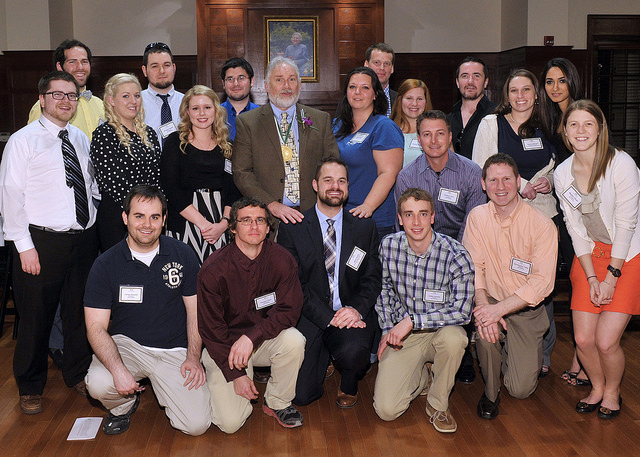
An award ceremony was held Tuesday, April 1, at the Harris Alumni Center to formally honor Ogle.
Presented since 1987, the First Citizens Bank Scholars Medal is UNC Charlotte’s most prestigious faculty award in recognition of excellence in research.
“Craig has earned the reputation within his discipline and around the world as an effective and respected scholar,” said Chancellor Philip L. Dubois. “He epitomizes what the First Citizens Scholar Medal represents through his innovative research, remarkable scientific impact, and steadfast commitment to preparing undergraduate and graduate students for their future careers.”
Ogle is a world-class researcher in organic chemistry; his studies have answered important questions and provided unprecedented insight and analysis about key synthetic chemical processes that are often central to creating organic compounds like pharmaceuticals and other drugs.
Working with colleagues, Ogle has conducted pioneering studies in the use of RINMR spectroscopy, which allows researchers to observe and measure exactly how two reagents interact during the course of a chemical reaction. As a result of this work, researchers all over the world have a unique perspective into the exact science behind a reaction’s complexities and nuances that always have existed but were never truly understood.
A member of the Chemistry Department since 1984, Ogle was promoted to full professor in 1996. He has authored more than 65 peer-reviewed journal articles; almost all are co-authored by students involved in his work. He has received numerous grants in support of his research from several agencies, most notably the National Science Foundation. He has served as director of UNC Charlotte’s Regional Analytical Chemistry Laboratory (RACheL) since its inception in 1996.
A graduate of Otterbein College, Ogle completed a master’s and doctorate in chemistry from the University of Arizona. He also served as a post-doctoral fellow at the University of Lausanne in Switzerland.
“Our longstanding partnership with UNC Charlotte and the presentation of the Scholars Medal reflect our ‘Forever First’ commitment to the people, businesses and communities who rely on us to the best bank we can be,” said Mark Horgan, area executive for First Citizens Bank in Mecklenburg, Union, Stanley and Cabarrus counties. “First Citizens is proud to help honor an exceptional faculty member’s leadership and scholarship and to further highlight the important contributions UNC Charlotte and its faculty are making in the community, state and world.”
Now in its 27th year, the Scholars Medal was created to spotlight the important contributions UNC Charlotte and its faculty are making – not only in its community but also throughout the Carolinas, the nation and the world. Past award recipients have influenced scholarship in a number of academic disciplines.
Words by Paul Nowell; images by Wade Bruton. More images can be found on flickr.
Biology Honors Alumnus Gained Research Experience With Practical Implications
When Yogin Patel came to UNC Charlotte as an undergraduate biology honors student, he arrived with a mission – to work in a lab with practical implications for its research. Patel, who graduated with a bachelor’s degree in biology with honors in December of 2012, says he found that in the lab of Shan Yan, assistant professor in the Department of Biology.
Patel and other students in the Yan lab uncovered a previously unknown surveillance mechanism used by cells to monitor DNA that is oxidatively damaged. In an unusual opportunity for an undergraduate student, Patel was first author with graduate student Jeremy Willis on a paper in the prestigious Proceedings of the National Academy of Sciences (PNAS). Another undergraduate honors student, Barry L. Lentz, joined fellow students and Yan on the paper. The researchers hope their work will open new options in drug development some day.
Patel also was first author on a paper in the Journal of Visualized Experiments (JoVE) about preparation of Xenopus laevis egg extract.
In high school, as Patel studied advanced levels of biology, he had developed a keen interest in research. Biotechnology and molecular biology courses opened his eyes to activity at the molecular level. He realized he needed access to a lab and other researchers to pursue his passion.
“I was really excited,” he says. “I wanted to do this myself and apply my ideas. But it is not something you just can go do. Meanwhile my father had colon cancer, and I was in the hospital with him.”
As he observed the oncologists working with his father and continued his independent reading, his enthusiasm for research in genomic instability grew. “I really wanted to become productive,” he says. “I really wanted to get my hands on research.”
Three months after joining Yan’s lab, Patel earned second place in the biology division in the Undergraduate Research Conference and later presented his research at the State of North Carolina Undergraduate Research and Creativity Symposium at Duke University. He and other students also visited local high schools and hosted students at UNC Charlotte to showcase the scientific method.
After graduation from UNC Charlotte in December 2012, Patel worked at the Levine Cancer Institute Cancer Pharmacology Department as a clinical lab assistant. He joined the lab of Hexin Chen at the University of South Carolina as a Ph.D. student in October 2013, starting research on cancer stem cell approaches for breast cancer.