Cancer Researcher Earns Honor From Charlotte International Cabinet
For her entrepreneurial approach and her scientific discoveries, UNC Charlotte distinguished cancer researcher Pinku Mukherjee has received the “Charlotte International Cabinet Patrick McCrory International Entrepreneur Award.”
As the Irwin Belk Endowed Professor of Cancer Research at UNC Charlotte, Mukherjee is transforming the ways in which cancer is diagnosed and treated. She has designed innovative approaches to more accurately detect breast cancer early and is developing targeted therapy and imaging for pancreatic, ovarian and colon cancers.
She has also shared her discoveries with the students she teaches at Charlotte and embodies the spirit of an internationally-minded entrepreneur, the cabinet indicated in its naming of her for the award.
This is the latest accolade for Mukherjee, who was honored a year ago with the O. Max Gardner Award – the highest faculty accolade given by the Board of Governors of the University of North Carolina. The award, established by a provision in the will of Gov. O. Max Gardner, recognizes UNC system faculty members who have “made the greatest contribution to the welfare of the human race.”
Mukherjee and other recipients of awards by the Charlotte International Cabinet received their awards on May 4 at the 19th Annual Mayor’s International Community Awards ceremony at the Blumenthal Performing Arts Center.
The awards recognize the contributions of the international community in the Charlotte region. The Charlotte International Cabinet sponsors the community awards as a collaborative program with the Office of the Mayor and the Office of International Relations.
Others who received awards included Mike Hawley, who received the Richard Vinroot International Achievement Award for his role as director and past chairman of the World Affairs Council and in promoting economic development within the international community in Charlotte.
Maha Gingrich received the Global Leader Award as an exemplary role model as a successful entrepreneur and working to bring international educational, cultural, and business opportunities to the region through programs including Dances of India.
Foreign-owned businesses receiving awards were Stantac, small business, Canada; Chion, medium business, Germany; and Rack Room Shoes, large business, Germany.
Biological Sciences Student Named Outstanding Graduate Teaching Assistant
Britney Phippen, a doctoral student in biological sciences, and Rahul Upadhyay, who is pursuing a master’s degree in mechanical engineering, are the 2015-16 recipients of the Outstanding Graduate Teaching Assistant Awards.
The Graduate School and the Center for Graduate Life present the awards each year. Each award winner receives a $500 prize and a plaque.
“The professoriate looks to you going forward,” Joan Lorden, provost and vice chancellor for academic affairs, said at a presentation of the awards. “We have a very diverse student population here not unlike what might be representative of the kind of institution where you would teach in the future. You have great people to learn from and great opportunity to do it at UNC Charlotte.”
Phippen, the award recipient at the doctoral level, was nominated by Tonya Bates and Michelle Pass of the Biological Sciences Department. They noted how much students appreciate Phippen’s passion and zest for biology, as well as her ability to explain things in a way that makes biology accessible for non-science majors.
“I know that the majority of my students will only be exposed to science in my classroom, as most will go on to major in other fields,” Phippen said. “However, these same students will have to make decisions in their lives that directly relate to biological principles, and they should be educated in their decisions.”
In addition to teaching the principles of biology lab and the genetics lab courses, she updated the a lab manual for a biology course, developed new lab activities and created innovative assignments.
Graduate teaching assistants assist faculty in teaching courses, preparing assignments, meeting with students, grading and other activities. All assistants receive training through the Graduate Teaching Initiative. Judith Krauss, faculty associate for the Center for Graduate Life and leader of the Graduate Teaching Initiative, hosted the awards ceremony.
This year’s judges were Scott Fitzgerald, sociology; Eric Heggestad, psychology; and Barry Wilkinson, computer science.
Nominees submitted applications with original classroom materials, undergraduate students’ evaluations, letters of recommendation from faculty supervisors, a teaching philosophy statement and other evidence of their skill in the craft of teaching and their commitment to improving student learning.
Words and Image: Karla Stanchina
College Alumni Receive Awards from Alumni Association
Distinguished College of Liberal Arts & Sciences alumni are among those honored in April by the UNC Charlotte Alumni Association for outstanding contributions to their professions, their communities and to the university.
“Some of the most rewarding experiences we associate with our University actually begin at graduation, when former students enter the Alumni Association,” said Madeline Keeter (’08), president-elect of the UNC Charlotte Alumni Association. “Alumni are an essential part of our University and are among UNC Charlotte’s most valued supporters.”
Held during the inaugural Alumniner Weekend, the UNC Charlotte Alumni Awards presentation ceremony recognized College of Liberal Arts & Sciences alumni U.S. Rep. Richard Hudson (’96), and Robyn Massey (’81), with the Distinguished Alumnus Award.
Hudson, who represents North Carolina’s 8th Congressional District, earned bachelor’s degrees in history and political science. In 2012, he was elected to his first term in Congress. Currently, he serves on the House Agriculture, the Education Workforce and the Homeland Security committees. A former Student Government Association president, Hudson has served on the Alumni Board of Directors. In his Washington, D.C., office, he displays his UNC Charlotte diploma and a 49ers jersey.
Massey earned a bachelor’s degree in mathematics and completed an MBA from Wake Forest University. Upon graduation from Wake Forest, she embarked upon a career with IBM that has spanned almost 30 years. The last 13, she has served as a project executive for IBM Global Services. From 2008-10, Massey served as president of the UNC Charlotte Alumni Association. She also was a board member of the UNC Charlotte Black Alumni Chapter, an advisory council member for the College of Liberal Arts & Sciences, and currently, she serves on the UNC Charlotte Foundation Board.
“Robyn exudes quiet determination and is committed to making the University and the greater Charlotte communities more engaging, active and inclusive,” said Nancy Gutierrez, dean of the College of Liberal Arts & Sciences.
The association also recognized Susan DeVore (’81), and Donnie Koonce (’81), with Distinguished Alumnus Awards. DeVore completed a Bachelor of Arts in Business Administration from the Belk College of Business, and Koonce graduated with a Bachelor of Arts in Economics.
Dhiaa Jamil (’78), received the Bonnie Cone Lifetime Achievement Award. He earned a bachelor’s degree in electrical engineering. Triple degree graduate Brett Tempest (’04, ’07, ’10), who is a faculty member in the Lee College of Engineering, was named Outstanding Young Alumnus. Melba Spooner (’79, ’85) received the Distinguished Faculty Award. Spooner, senior associate dean in the College of Education, completed a bachelor’s degree in elementary education and a Master of Education. She earned a doctorate from UNC Greensboro in 1991. Former Vice Chancellor for Student Affairs Charles Lynch, who retired in summer 2007, was presented the Honorary Alumnus Award.
Biological Sciences Professor Receives Statewide Teaching Honor
Stanley Schneider from the Department of Biological Sciences in the College of Liberal Arts & Sciences is one of the recipients of the 2016 UNC Board of Governors Awards for Excellence in Teaching.
This annual honor recognizes one professor at each of North Carolina’s public institutions. The 17 recipients were nominated by individual campus committees and selected by the Board of Governors’ Committee on Personnel and Tenure. Each award winner will receive a commemorative bronze medallion and a $12,500 cash prize.
As a teacher, one of Schneider’s goals is to change the way students think about and live on Earth. “I want them to experience awe and a sense of privilege and responsibility for living on this planet,” he says.
Schneider’s passion for animal behavior, social insects including honeybees, and the evolution of social behavior is infectious, and his students thrive under his guidance. Schneider and colleagues explore how honeybees communicate, with potential implications for honeybee health.
Teaching is a social interaction, as the contagious enthusiasm of the teacher can capture students’ imaginations and help them dream, Schneider says. Excellent teachers are rigorous and fair, and they demonstrate respect for students by holding them to high standards of performance by providing clear, organized and relevant lectures, he says.
Schneider exposes students to the process of conducting research as he views this as the primary means by which students learn how new information is generated and synthesized into an existing body of knowledge. Since joining the UNC Charlotte faculty in 1985, Schneider has worked with over 150 graduate and undergraduate students through individualized instruction, many of whom have gone on to become productive biologists, teachers, researchers and entrepreneurs.
“I think it’s very important to take students through the entire process to completion, and completion is having the results published in a peer-reviewed journal,” he says. “They understand the importance of communicating your findings with the larger audience. That benefits them, and it benefits us and the university.”
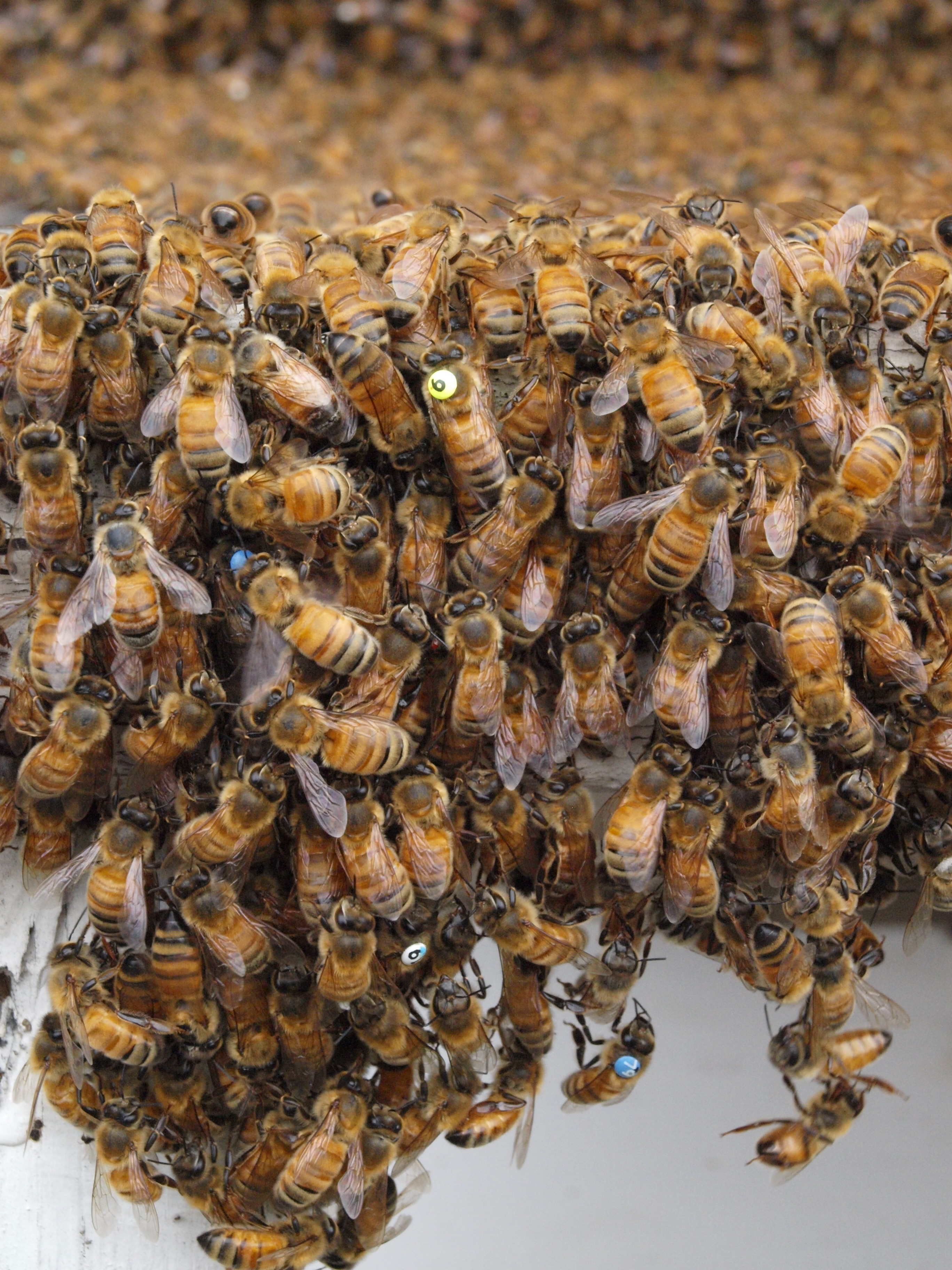 Close to 60 percent of the Biological Sciences Honors students working with Schneider have published with him, some with multiple publications. Because of the finite time period during which undergraduates work with him, obtaining enough data to publish can at times prove difficult. This remains a goal for him, however.
“In a university, teaching and research are inextricably interlinked,” he says. “Lectures give people the background information necessary to train them to start applying it. Research training trains them to generate that knowledge themselves. So, you can’t separate the two. The interaction of those two is what moves education forward and what moves human understanding forward.”
Because of his research on honey bees, Schneider frequently is invited to give talks to beekeeping associations and gardening and birding clubs. Given the worldwide decline of pollinators, he sees these talks as an important public service, as he draws upon his research to teach the general public more about the role they can play in helping to combat the problem.
Schneider earned a doctoral degree in animal behavior from the University of California at Davis in 1984. His bachelor’s and master’s degrees in biology are from Texas State University.
College Faculty To Lead CTI 2016 Seminars
College of Liberal Arts & Sciences faculty will lead Charlotte Teachers Institute 2016 seminars on a wide variety of engaging, interdisciplinary topics for Charlotte-Mecklenburg teachers from all grade levels and subject areas.
CTI recently announced its new seminars, which also will be led by faculty members from UNC Charlotte College of Education and Davidson College. The online application deadline for CMS teachers from all subject areas in grades preK-12 is March 10.
Interested CMS teachers can meet the seminar leaders and learn more about the seminars and the application process at an open house on Thursday, Feb. 25 from 5:30 to 7:30 p.m. at UNC Charlotte Center City, 320 E. 9th Street. Interested CMS teachers can register for the open house at www.charlotteteachers.org.
CTI’s 2016 seminars include:
-
Literacy and Literacies in the 21st Century led by Kyra Kietrys, Hispanic Studies, Davidson College
-
How Science Is Done: A Behind the Scenes Look at Scientific Research, Susan Trammell, Physics & Optical Science, UNC Charlotte
-
The Many Faces of Capitalism around the Globe – Past and Present, Jurgen Buchenau, History, UNC Charlotte
-
Writing with Power: No Fear Here, Brenda Flanagan, English, Davidson College
-
FUNdamental Ideas in Math for Grades PreK-12, Harold Reiter, Mathematics & Statistics, UNC Charlotte
-
It’s a Small World! Exploring Science at the Tiniest Scale, Marcus Jones, Chemistry, UNC Charlotte
-
Tracing the Legacy of Hispanic Cultures – 1492 to Today, Angela Willis, Hispanic Studies, Davidson College
-
Exploring Memoir – From Picture Book to Digital Story, Brian Kissel, Reading & Elementary Education, UNC Charlotte
CTI Fellows collaborate with higher education faculty in these long-term seminars to create innovative curricula for their own students. All eight seminars begin in April and continue through November, including a summer reading and research period. Each CTI Fellow receives a $1500 stipend and three continuing education credits for their curriculum development work.
CTI is an educational partnership among CMS, Davidson College and UNC Charlotte, designed to strengthen teaching in CMS by cultivating content knowledge, creativity, leadership skills and collaboration among local public school teachers.
Pictured: CMS teachers work with UNC Charlotte Professor Harold Reiter in a 2015 seminar.
Student Grows Campus Biodiversity With Re-Wilding Project
What began as a biological sciences’ extra-credit assignment bloomed into a project that is helping to slow the erosion of sediment into Toby Creek by converting a barren parking lot into a diverse natural habitat.
“We had been discussing in class how important increasing the type of plants on campus would be to increase overall biodiversity,” said Ian O’Shaughnessy, an undergraduate biology student who designed the project to re-wild Parking Lot 27. Re-wilding refers to returning an ecosystem to a previous state.
“I was walking on campus, and I noticed we had a lot of the same types of landscaping,” O’Shaughnessy said. “It was all manicured Bermuda grass and tall trees. I thought that increasing the number of plants and animals could help improve biodiversity.”
 Adam Reitzel, an assistant professor in biological sciences, had challenged O’Shaughnessy and the other students in his conservation biology class to consider the issue of biodiversity on UNC Charlotte’s campus.
“I have a personal passion for giving students the opportunity to engage in science,” Reitzel said. “Students have many opportunities to explore science in hands-on ways, and sometimes they are just not aware of that. I’m really interested in having my students engage outside the classroom and think about the relevance of what they’re learning in the classroom.”
The assignment called for students to present their conservation-based project plans to faculty members. O’Shaughnessy’s project moved quickly from theory to practice, as he presented his idea to university landscape architect Peter Franz, biological sciences faculty members including Carrie Wells and UNC Charlotte Facilities Management team members. The university team endorsed the project and suggested Lot 27 near Harris Alumni Center as an area that needed help.
“The whole parking lot was actually part of a sustainable design that intended for the sediment to go into a retention pond,” O’Shaughnessy said. “But it hadn’t worked out that way because the erosion happened too quickly. Maintenance had actually stopped maintaining the hill because it was futile. Every time it rained, all the mulch washed directly into the parking lot.”
The sediment and mulch then flowed into Toby Creek and the surrounding watershed.
 O’Shaughnessy researched hundreds of plants for their ability to hold the soil in place and attract insects and animals, consulting with Paula Gross of the UNC Charlotte Botanical Gardens and Scott Taylor, an expert on native plants.
“We wanted to make sure that all the plants were native to the area,” O’Shaughnessy said. “So a lot of time was spent researching the ranges of different plants. We wanted to make sure that they served their role to help trap the sediment. I did some research into that issue, as well as increasing biodiversity and what would provide a food source for different things.”
O’Shaughnessy completed the planning phase within a few weeks, Reitzel said. “Then it came down to, ‘How are we going to get the money to do the project?” he said. “The idea’s here, we have a lot of interest.’ So that’s where Ian and I teamed up again in order to locate some funds.”
The Charlotte Green Initiative, a UNC Charlotte student group that focuses on sustainability efforts, provided funding. O’Shaughnessy recruited volunteers from the university and the community to install the excelsior matting and plants during the spring semester.
 In the months since, plants have flowered and attracted insects, birds and other animals. For the team that helped O’Shaughnessy bring his vision to life, the work is a testament to student creativity and initiative.
“He had the insight and drive to initiate his project and the knowledge to implement it,” Franz said. “I was impressed with his dedication to environmental sustainability. Typically when students come to me about projects like this, I’m amazed at their commitment to it and knowledge they have about the subject. The benefit to the campus and community is to demonstrate the many components of sustainability. Since it is really a system-based concept, every demonstration project like Ian’s helps educate the community.”
For O’Shaughnessy, the project gave an opportunity to live his beliefs.
“I hope that people will see that a very simple idea when implemented can turn into something amazing,” he said. “There is really no insignificant effort. You don’t have to do something huge to make a difference. As a scientist, you have the obligation to do the morally right thing. You should use what you have learned for the good of everyone.”
Words: Skye Allan | Images: Lynn Roberson
Graduate Student Turns to Nanoscience to Seek Clean Water Solutions
As people worldwide cry out for safe drinking water, UNC Charlotte master’s degree student Billy Johnson has discovered a way to help, through nanoscience.
Working with his UNC Charlotte faculty mentor Jordan Poler, Johnson has developed a novel nanomaterial they believe can push science forward in the removal of certain potential carcinogens from water. Last fall, Johnson received the Thomas D. Walsh Graduate Research Fellowship to support his work.
“I’m passionate about preserving our environment, and doing my part to make sure that future generations get to breathe clean air, and drink clean water,” Johnson says. “Our society relies heavily on processes that are detrimental to the environment, and we’re already starting to see some of the effects in the form of climate change. We have to focus on resolving the environmental issues.”
All active water resources contain natural organic matter. These compounds, specifically humic and fulvic acids, pose a potential health hazard. Modern water treatment techniques depend upon chlorine to destroy bacterial pathogens. However, the natural organic matter reacts with the chlorine to form disinfection byproducts with human health risks.
“Natural organic matter is found in all active water sources, so we need to remove it before the water treatment process,” Johnson says. “This NanoResin, as we call it, has proven to be more effective than the currently available products. Also, our NanoResin can be readily regenerated and reused by simply adding it to a brine solution, or salt water. It’s a sustainable solution to a difficult environmental problem.”
Nanoscale science focuses on materials that range from about 1-100 nanometers. A nanometer is about 1/1000th the thickness of a hair. For nanomaterials to work, they must be assembled into useful structures, such as a carbon nanotube, or nano-sized cylinder of carbon atoms.
Creating Useful Materials to Address Pressing Issues
“In our research group, we focus on fundamental systems at the nanoscale with regard to applications of materials on the macroscale,” Poler says. “So we’re more of a materials science group, creating useful materials with applications in mind. Our material of choice is nanostructured carbon, or more specifically, carbon nanotubes. Carbon nanotubes are the strongest materials known to man, and they have an extremely high aspect ratio with nearly unrivaled specific surface area. However, they are not dispersible in water, so they immediately aggregate and are effectively useless.”
To tackle this problem, Johnson developed hybrid nanoparticles that use the nanotubes as scaffolding for a hydrophilic polymer. The nanotubes can then be dispersed into the aqueous systems. The anion-exchange resin polymer conforms itself to the immense surface area of the nanotubes, coating the nanotubes and removing the contaminants from the water.
 The researchers have seen significant decreases in contaminant concentration, even at very low concentrations of the contaminants. Their studies suggest that their nanomaterial is three times more efficient than currently available removal technologies.
Johnson and Poler believe they have a product that could eventually make it into water treatment facilities as a viable solution. They are preparing an academic paper for publication and exploring options for the material.
The Poler Research Group works with students from the Nanoscale Science and the Optical Science and Engineering doctoral programs, the Chemistry master’s program and undergraduates from Chemistry, Physics and Optical Science, Biological Sciences, Engineering, and Mathematics and Statistics. High school students also join the team from time to time.
“Dr. Poler continually pushes us to grow as scientists, and takes every opportunity to teach us,” Johnson says. “I have grown immensely as a scientist and his mentoring has been the driving force behind that.”
Poler saw potential in Johnson from the first class Johnson took with Poler. He has seen Johnson continue to grow as a researcher and leader as Johnson taught general chemistry labs and in the research group.
“He started strong in the lab and showed dedication to safety, attention to detail, and being productive,” Poler says. “He has developed into a very competent and creative research student. I expect him to find success at all stages of his career.”
The work Poler does with Johnson and other students continues not only to advance science, but to also grow students.
“I believe the path toward success starts with being an effective, purposeful, and compelling communicator,” Poler says. “Beyond the laboratory, our students need guidance developing their careers. I work closely with my students to help them prepare for poster and oral presentations. My mantra to them is that everything you write, or draw, or say should be purposeful. Every chart, table, picture, or graph should be presented as if it was going into your thesis, or dissertation, or a publication, or your Nobel Prize acceptance speech.”
Poler considers each student’s needs when acting as a mentor. One thing that remains constant is a focus on experiential learning.
“The importance of an open-ended research experience for students is critical,” he says. “Getting students into our research labs is transformative for them. I am always amazed at their growth and their development toward independent thought.”
For Johnson, the potential for his work to make its way into water treatment plants holds special meaning. After earning his bachelor’s degree in Chemistry at UNC Charlotte in 2011, he worked as a chemistry technician at a water treatment facility in Gastonia. He then worked in quality assurance at Special Metals Welding Products Company before beginning his graduate studies in fall 2014. He plans to pursue a doctorate in a materials chemistry program focusing on environmental issues.
“I arrived at that field of study based on my passion for chemistry, but I also wanted to have applications in mind when developing new materials,” he says. “Materials science can be looked at as the link between fundamental studies of the physical sciences and engineering. I’m focusing on environmental issues because this is the only planet we get. If we destroy this one, there isn’t a backup.”
Words: Brittany Algiere | Image: Lynn Roberson
Research Readiness: Undergraduates Work With Professors
As first author of a research paper in the prestigious academic journal PLOS ONE, biology undergraduate and Charlotte Research Scholar Jenna Brown picked up an impressive honor – and a new nickname.
“Becoming a published author as an undergraduate student still feels surreal to me,” says Brown, who co-authored the paper with mentor Dennis Livesay, bioinformatics and genomics professor. “It was fun being able to share the news with my family and friends, who now refer to me as “Scientifically Suitable” after hearing about reviewers’ comments.”
Brown is one of hundreds of UNC Charlotte undergraduates who have participated in the Charlotte Research Scholars initiative at UNC Charlotte. Each summer, students apply for the 10-week program. Those chosen receive a scholarship to work closely with faculty mentors conducting research. They also participate in professional development sessions to better prepare them for graduate school and careers.
Brown is embracing the serious side of her nickname, using these early research opportunities as fuel for her passion. “The paper was never meant to be the end point for me, though it was certainly a goal,” she says. “The most exciting part of this for me is that it isn’t over.”
The work has made progress in the search for a weak spot in the architecture of a group of enzymes that are essential to antibiotic resistance in a number of bacteria, using a complex modeling program that helps analyze the physical dynamics of large, structurally complex protein molecules.
“This work was the first research experience I had, and for me it involved a learning curve,” Brown says. “I have gained confidence in my ability to function as a part of a professional academic team, become more comfortable with computers, developed into a seasoned public speaker, and gained a better understanding of what I hope to do post-graduation.”
A senior, she is currently applying to pharmacy schools, marrying her love of chemistry and biology with her interest in a medical career.
 Another Charlotte Research Scholar, Henry Tigri, worked with mentor Michael Turner, a professor in the Criminal Justice and Criminology Department, to research the relationship between gang membership and firearms and bully victimization and firearms.
“Dr. Turner became a great mentor, in research specifically, criminology broadly and in life in general,” says Tigri, who graduated with degrees in criminal justice and psychology. “My role included selecting our research topic, discussing how we might get answers to our research questions, collecting data, and analyzing that data. Dr. Turner gave me the reins, but worked with me to explain the processes, including how to work with the statistical software.”
Tigri published two papers, one with fellow student Jennifer Devinney, in the American Journal of Criminal Justice and the International Journal of Offender Therapy and Comparative Criminology. His research experiences stood out when he applied to graduate school, he says, and he currently is pursuing his master’s degree in accounting at Florida State University.
“Research teaches analytical and critical thinking, problem solving, troubleshooting, attention to detail and other skills,” he says. “I would go so far as to say that my research experience has taught me more usable skills that are applicable in the real world and the working world than the rest of my undergraduate education as a whole.”
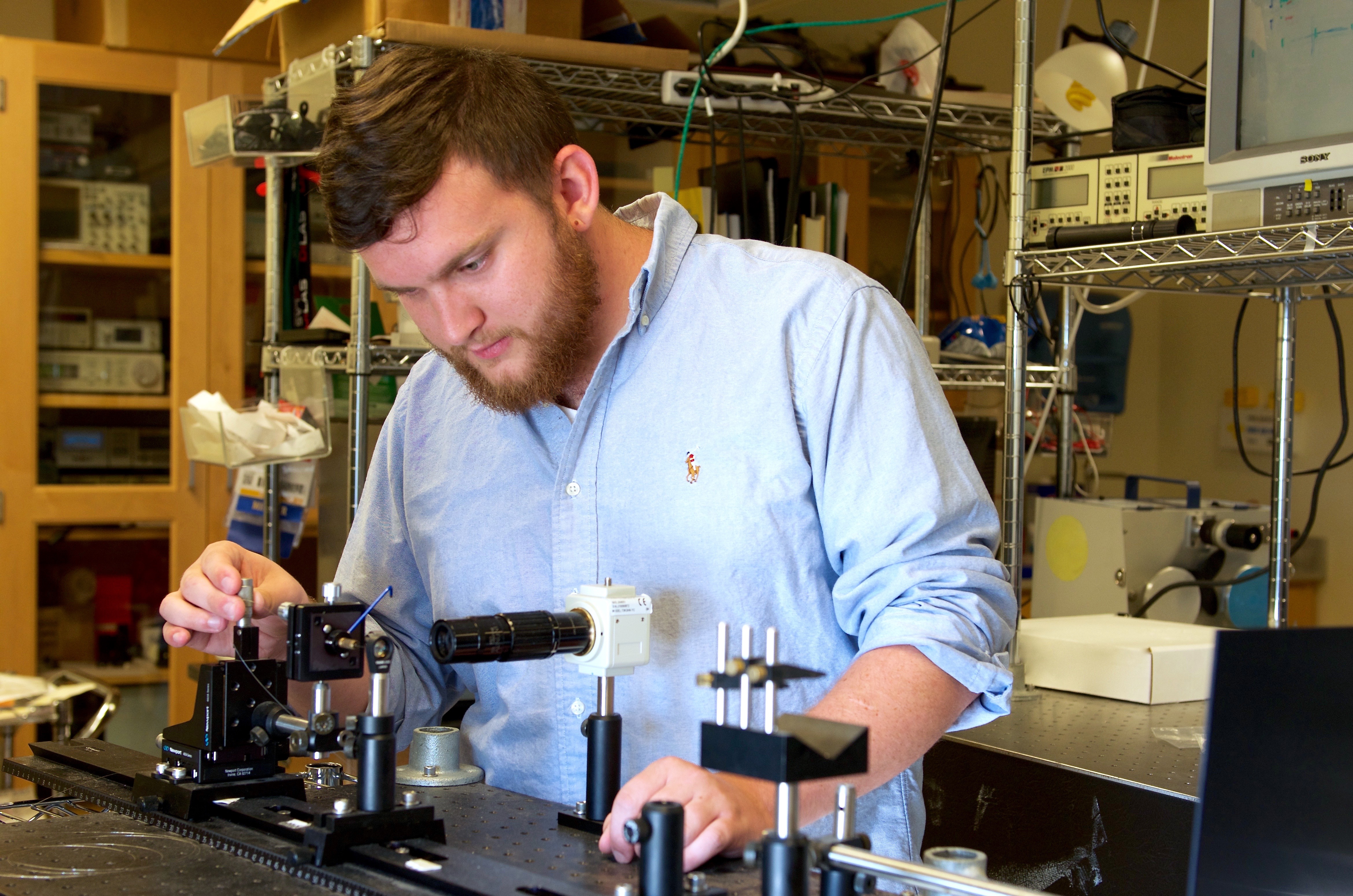 Like Tigri and Brown, physics student Luke Hardy worked closely with his mentor, physics and optical science professor Nathaniel Fried, researching the thulium fiber laser as an alternative to conventional lasers. Their work has resulted in papers in major journals and conference presentations.
“Carrying out research is not just sitting in a lab and doing experiments,” says Hardy, who now is pursuing his doctoral degree in optical science and engineering at UNC Charlotte. “A big part is explaining what you do, why it is important, and how you are able to do it. Being faced with multiple situations where I had to explain what I was doing in front of audiences has helped me overcome my fear of public speaking.”
Fried meets with students each day to discuss individual projects, which keeps the pace moving, Hardy says.
“All research has its dead ends and hard decisions; it wouldn’t be research if it didn’t,” he says. “Because Dr. Fried talks with us frequently, it helps us decide on the best path possible with our research. The hands-on aspect of the lab helps you visualize and attack problems in the classroom a lot easier.”
Hardy knew he wanted to use his knowledge and interest in engineering and science to help others.
“My father had a serious issue from a urinary stone blocking his urinary tract,” he says. “He was in the hospital for a while and needed surgery to remove the stone. I thought that if there was an easier way to destroy stones inside of the body, then I would love to help make that possible.
Words: Brittany Algiere | Images: Lynn Roberson and Aaron Cress
Researcher Seeks to Unlock DNA Secrets to Combat Deadly Diseases
Sleeping sickness, Chagas disease and other devastating illnesses threaten the lives of millions of people and livestock worldwide, particularly in developing Latin American and African countries. While tsetse fly and other insect bites spread the diseases, the true culprits are parasites that so far have defied efforts to combat them.
One reason for the difficulty in dealing with these trypanosomatid parasites is their unique mitochondrial DNA structure, known as kinetoplast DNA. UNC Charlotte mathematician Yuanan Diao is working with researchers across the country to unlock the secrets of the organisms’ DNA.
“When we talk about treating a disease, one approach is to attack its replication process and interrupt it so it cannot reproduce,” said Diao, chair of UNC Charlotte’s Department of Mathematics and Statistics. His research interests include Knot Theory and Geometrical Topology.
“If you understand the DNA of an organism well enough, then you could develop a drug that actually interrupts this process,” he said. “Unfortunately in this case, we still do not understand exactly how this DNA works and how it is replicated. Therefore, we have no idea how to attack it. If there is any hope, understanding it will be the first step. Without understanding, there is no hope.”
The DNA in these organisms is organized into a unique network containing several thousand interlocked short circular DNA chains (called minicircles) and a handful of longer circular DNA chains (called maxicircles). The kDNA is confined within a cyclinder, called the kinetoplast disk. In that disk, the DNA concentration is comparable to that of the bacterial nucleoid. While scientists have been able to gain some knowledge about the networks, their function and origin are still largely unknown.
Biologists have qu estioned whether the interlocking circles connect for a reason, or randomly, and the mathematical models Diao has developed help researchers to study this question.
“The numerical evidence we have obtained indicates that, when you have a lot of the minicircles crowded in a confined space like the kDNA disk, it is natural for them to form a complicated network through linking between adjacent minicircles,” Diao said. “So, the kDNA probably doesn’t really need any other special mechanism for the minicircles to form a complicated network as having been observed by us.”
When these results are interpreted in the context of the mitochondrial DNA of the trypanosome, they suggest that confinement plays a key role on the formation of the linked network, that is, the mere fact that there are too many minicircles crowded in a small space would lead to the formation of a complicated network.
Diao has drawn upon work he did 20 years ago, which he published in an academic paper at that time. That paper considered from a pure mathematical perspective how circles contained in a tight space would interact with each through topological linking. A colleague, Javier Arsuaga of the University of California at Davis, realized the potential connection of that paper and the minicircle network problem in kDNA and approached Diao about collaborating.
They have published academic papers together, including “The effect of volume exclusion on the formation of DNA minicircle networks: implications to kinetoplast DNA,” in the Journal of Physics, along with colleagues K. Hinson and Y. Sun of UNC Charlotte and “Orientation of DNA minicircles balances density and topological complexity in kinetoplast DNA,” in the journal PLOS ONE, along with Victor Rodriguez of Columbia University and Michele Klingbeil of University of Massachusetts.
“Understanding the kDNA network structure is a huge deal,” Diao said. “From a purely mathematical point of view, our research does not produce very deep theorems. However, we are making progress in understanding the kDNA and our work can have a significant impact.”
Words: Lynn Roberson | Image: Centers for Disease Control and Prevention, Dr. Mae Melvin
The Live Wire Features UNC Charlotte Botanical Gardens
On this episode of The Live Wire, UNC Charlotte Botanical Gardens Director Jeff Gillman shares insights into all that the Botanical Gardens has to offer and what’s ahead for this community treasure.